Polyvinyl Alcohol 101: Grades, Applications, and How to Choose a Professional PVA Supplier
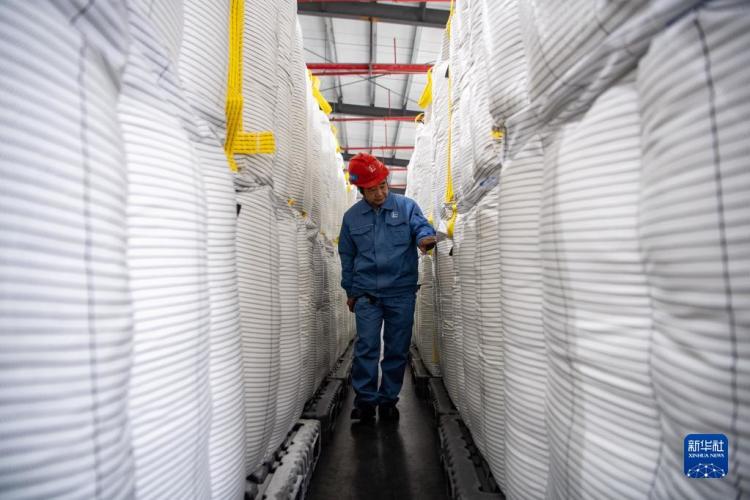
Polyvinyl alcohol (PVA) is a water-soluble synthetic polymer used across adhesives, textile sizing, paper coating, packaging films, construction materials, and pharmaceuticals. Its value comes from a combination of strong film-forming ability, high adhesion, and non-toxic behavior. For buyers at the awareness and research stage, the practical question is not only what PVA is, but which grade to specify and which supplier can deliver consistent industrial-grade material at scale. This guide provides the full picture: polymer basics, grade selection, application patterns, verified market context, supplier evaluation criteria, and FAQs.
What Is Professional Polyvinyl Alcohol (PVA)?
Professional polyvinyl alcohol is the industrial-grade form of a water-soluble polymer manufactured by the alcoholysis of polyvinyl acetate (PVAc). It is supplied as a white powder or flake. The two broad families are fully hydrolyzed PVA (typically 98–99% hydrolysis) and partially hydrolyzed PVA (typically 87–89% hydrolysis). Fully hydrolyzed grades dissolve in hot water above 80°C, while partially hydrolyzed grades are cold-water soluble.
This distinction matters in formulation. Cold-water-soluble grades such as PVA 1788, PVA 2488, and PVA 0588 are easier to process in low-energy mixing systems. Hot-water-soluble grades such as PVA 1799 and PVA 2499 provide higher film hardness, better abrasion resistance, and stronger water resistance after film formation — properties that are essential for textile warp sizing and water-resistant paper coating.
Why PVA is Used Instead of Starch, CMC, or Other Binders
PVA is often compared with starch and carboxymethyl cellulose (CMC). Broadly, PVA delivers better film-forming ability, higher tensile strength, and more stable viscosity control. In adhesive formulations, PVA provides stronger bonding to paper, wood, and mineral surfaces. In textile sizing, fully hydrolyzed PVA reduces yarn breakage more effectively than starch and can be removed with simpler desizing water. The trade-off is cost: PVA is a higher-value polymer, so formulators typically blend it with starch or CMC when they need to control cost while maintaining performance.
Market Context: PVA Demand and Supply in 2026
PVA demand is supported by clear global data. Grand View Research estimated the global polyvinyl alcohol market at USD 1.21 billion in 2025, with a projected value of USD 1.66 billion by 2033. China remains the world’s leading exporter of PVA in primary forms, with export values reaching approximately USD 366.6 million in 2024, according to UN Comtrade. The PVA films segment is also expanding at a CAGR of 7.1% (2026–2034), driven by water-soluble and biodegradable packaging demand.
Within China’s consumption structure, the largest application share is polymerization aids at 38%, followed by fabric sizing and pulp at 20%, and adhesives at 12% (China Industrial Research Institute / Elephchem, 2024). For buyers, this means a professional PVA supplier must balance high-volume commodity supply with technical support for specialized applications such as adhesives, textile sizing, paper coating, and biodegrable films.
PVA Grades and Specifications Explained
PVA grades are named by a four-digit code that indicates approximate degree of polymerization and hydrolysis. For example, in PVA 2488, the “24” indicates a degree of polymerization around 2400, and the “88” indicates a degree of hydrolysis of 87–89%. The higher the degree of polymerization, the higher the viscosity and typically the stronger the film. The degree of hydrolysis, meanwhile, determines water solubility and reactivity with other chemicals.
| Grade | Hydrolysis | Viscosity (mPa·s) | Solubility | Primary Uses |
|---|---|---|---|---|
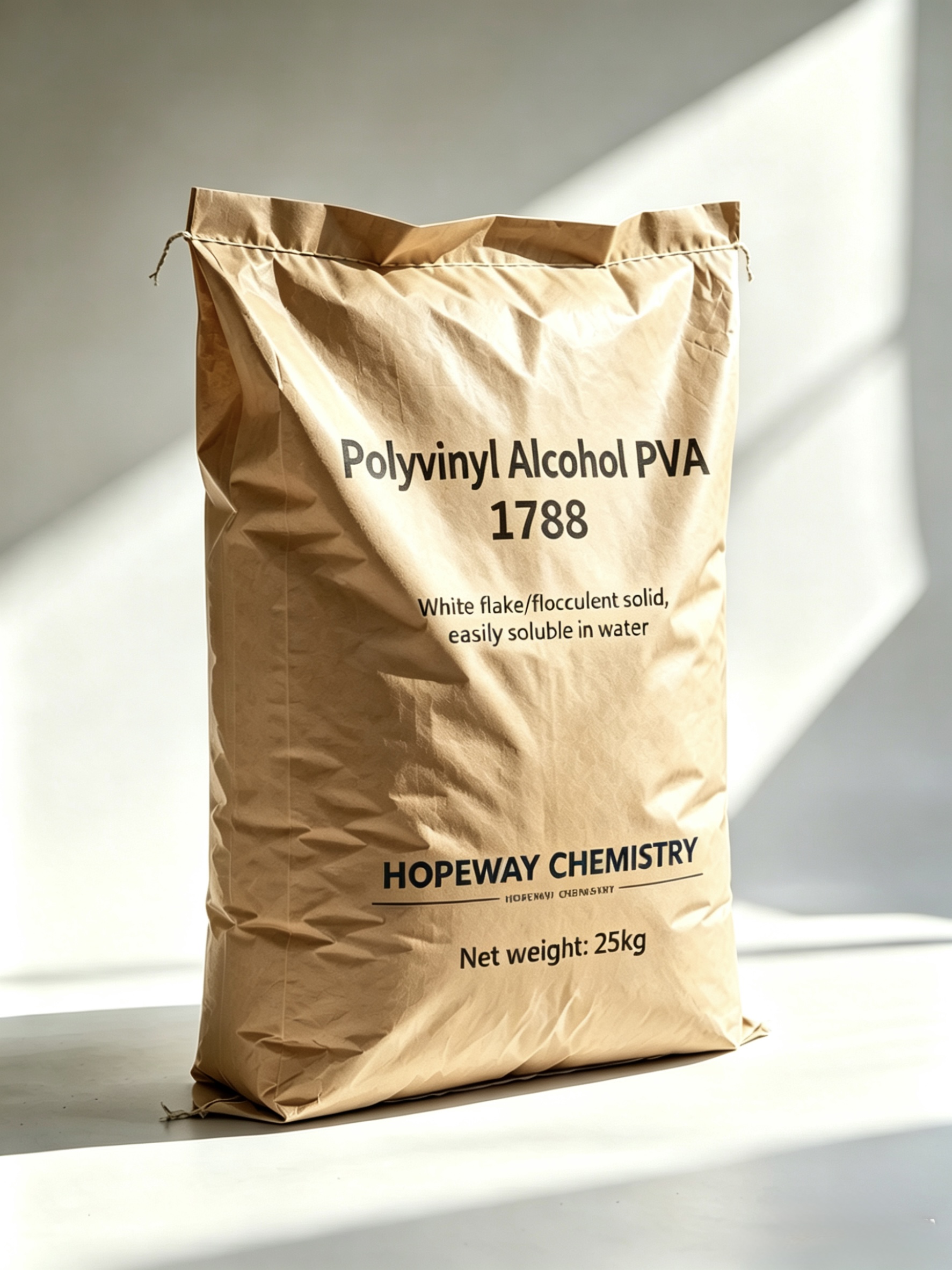
| PVA 1788 | 87–89% | 20.5–28 | Cold water | Construction glue, wall putty, paper sizing, adhesives, ceramic binder, water treatment |
| PVA 2488 | 87–89% | 44–55 | Cold water | Tile adhesive, waterproof mortar, high-viscosity glue, wood adhesive, textile sizing |
| PVA 2688 | 87–89% | 55–65 | Cold water | High-solid construction glue, thick exterior coating, special carton adhesive, mineral binder |
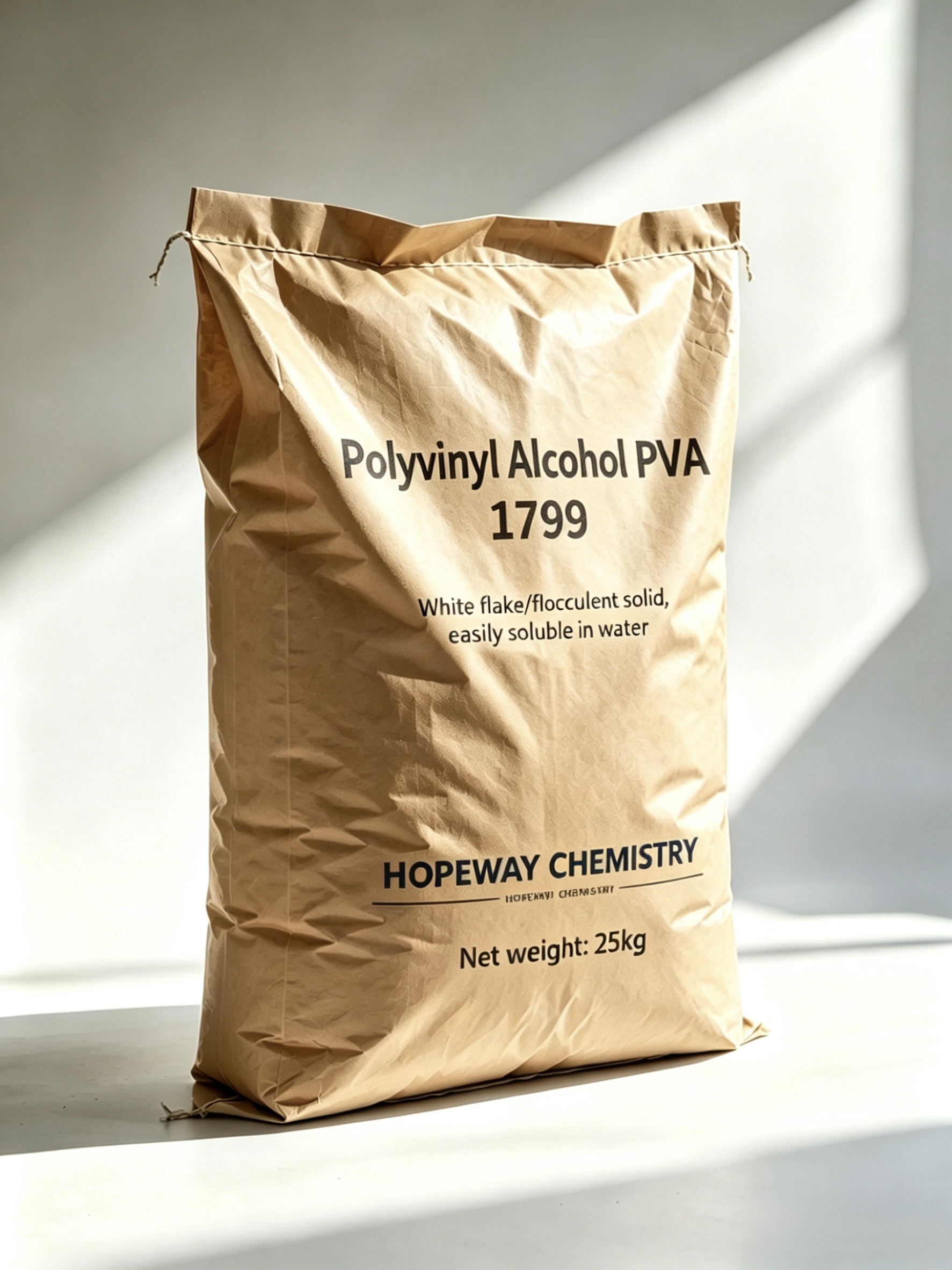
| PVA 1799 | 98–99% | 22–30 | Hot water >80°C | Textile warp sizing, high-temperature adhesive, paper coating, optical film raw material |
| PVA 2499 | 98–99% | 45–58 | Hot water | High-density fabric sizing, high-strength PVA fiber, PVB resin raw material, cement reinforcing |
| PVA 0588 | 87–89% | 4.5–6.0 | Cold water | Protective colloid for VAE, cosmetic thickener, low-viscosity glue, ink coating |
| PVA 0599 | 98–99% | 5–7 | Hot water | Pharmaceutical coating, slow-release medical substrate, specialty resins, fine chemical dispersant |
For general construction and paper applications, PVA 1788 and PVA 2488 are the most common partially hydrolyzed grades. For textile warp sizing, PVA 1799 is the typical fully hydrolyzed grade because of its high film hardness and abrasion resistance. For pharmaceutical and food-contact applications, PVA 0599 is a fully hydrolyzed low-polymerization grade with strong adhesion and excellent film-forming properties, though specific regulatory qualification is still required by the buyer for the final application.
Polyvinyl Alcohol for the Adhesive Industry
In adhesive formulations, PVA functions as the primary film-forming binder or as a modifying co-binder that improves viscosity stability, bond strength, and film transparency. Partially hydrolyzed grades such as PVA 1788 and PVA 2488 dissolve in cold water and are widely used in stationery glue, carton re-moistening adhesive, wood adhesive, and high-viscosity construction glue.
PVA 2488 is especially common in construction-related adhesives such as tile adhesive and waterproof mortar, where higher viscosity contributes to better anti-sag behavior and film build. PVA 2688 extends this to high-solid construction glue, thick exterior coating, and special carton adhesive, where a high viscosity of 55–65 mPa·s provides the required body and bonding strength.
PVA is also the protective colloid and stabilizer in VAE (Vinyl Acetate Ethylene) copolymer emulsions. In this role, PVA stabilizes the emulsion during polymerization and improves the final adhesive’s water resistance and mechanical performance. HOPEWAY produces VAE 705, VAE 706, VAE 707, and VAE 707H with solid contents of 54.5–55% minimum and minimum film forming temperatures of 0°C; all are non-toxic, zero-formaldehyde, fully water-dilutable and contain PVA as the stabilizer and protective colloid.
VAE Grades at a Glance
| Model | Solid Content | Viscosity (mPa·s) | Ethylene Mass Fraction | Key Applications |
|---|---|---|---|---|
| VAE 705 | ≥55% | 2500–3500 | 14–18% | Wallpaper adhesive, wood splicing glue, book binding, cement mortar modification |
| VAE 706 | ≥54.5% | 500–1000 | 16–18% | Insulation mortar, waterproof coating, fireproof coating, concrete repair, tile back coating |
| VAE 707 | ≥54.5% | 1000–1500 | 16–18% | External wall thermal insulation mortar, construction base coating |
| VAE 707H | ≥54.5% | 1000–1500 | 16–18% | Low-cost waterproof coating, dry-mixed mortar binder, exterior elastic coating |
VAE 707H differs from VAE 707 mainly in a tighter residual vinyl acetate limit of 0.5% maximum, which is useful when lower odor and higher purity are required.
Polyvinyl Alcohol for Textile Sizing
Textile warp sizing is one of the oldest and largest technical uses of PVA. The polymer coats the yarn surface to increase tensile strength, reduce loom breakage, and lubricate fibers as they pass through high-speed looms. After weaving, the size layer is removed by water washing, and PVA’s biodegradable desizing waste water makes it a more sustainable option than some synthetic size materials.
The standard grade for cotton and chemical fiber warp sizing is fully hydrolyzed PVA 1799. In typical operation, PVA 1799 is dissolved in hot water at 80–95°C, applied in a continuous sizing machine, dried at high temperature, and later desized by water washing. Fully hydrolyzed PVA is preferred because it forms a harder, more abrasion-resistant film, which is required for high-speed weaving. PVA 2499, with higher viscosity of 45–58 mPa·s, is used for high-count, high-density fabric sizing where a stronger film is required.
Special requirements for textile sizing include low ash content to avoid fabric staining and biodegradable desizing wastewater. For embroidery water-soluble backing paper, low-hydrolysis specialty PVA grades are typically used to achieve complete dissolution in cold water. HOPEWAY’s product range includes partially hydrolyzed grades and fully hydrolyzed grades to cover both conventional weaving and specialty water-soluble applications.
Polyvinyl Alcohol for Paper Coating and Packaging
In the paper industry, PVA is used for surface sizing and coating to improve smoothness, printability, oil resistance, and tensile strength, while preventing ink penetration. It is also used in paper adhesives for carton lamination, book binding, and corrugated box sealing, where it provides high initial tack and permanent bonding strength.
For paper surface sizing, PVA 1788 is the commonly specified cold-water-soluble grade. It is dissolved in water and applied by an online sizing machine, followed by roller drying and calendering. This operation fits high-speed paper machines running at 300–800 m/min with coating oven temperatures of 90–120°C. Buyers should look for a low-foam PVA grade with stable viscosity under high-speed stirring and compatibility with kaolin coating pigment. For food packaging cartons, low odor and food indirect contact certification are additional requirements.
HOPEWAY also supplies fully hydrolyzed grades such as PVA 1799 for water-resistant paper coating and PVA 2499 for more demanding barriers, enabling manufacturers to select by water resistance and film strength requirement.
Polyvinyl Alcohol for Biodegradable Packaging Films
PVA is increasingly used to produce water-soluble films for biodegradable packaging, laundry pods, agricultural seed coating, and embroidery backing. The global market for PVA films for packaging is expanding at a CAGR of 7.1% between 2026 and 2034, driven by demand for water-soluble and biodegradable solutions. This trend makes PVA a material of interest for brand owners and packaging converters looking for alternatives to conventional plastics.
For film extrusion, grade selection depends on the required dissolution temperature and mechanical strength. Low-temperature water-soluble specialty grades are used when the film must dissolve quickly in cold or lukewarm water. Higher polymerization grades are used where physical strength and toughness matter more. HOPEWAY’s PVA portfolio includes low-temperature water-soluble grades and high-strength PVA fiber, which can be combined in film formulations depending on the target application.
Because PVA films are hygroscopic, buyers should also consider packaging conditions and humidity resistance during transport and storage, as the film’s performance depends on environmental moisture.
Polyvinyl Alcohol for Construction
The construction industry is the largest global consumption segment for PVA. In interior wall putty and general construction glue, PVA acts as a film-forming agent, binder, anti-crack additive, and water retention agent. It is mixed with inorganic fillers such as calcium carbonate and talcum powder, then applied by spraying or roller coating in residential renovation projects.
For cement-based systems such as tile adhesive, waterproof mortar, and exterior insulation mortar, the applicable grades are partially hydrolyzed PVA 1788 or 2488, with a degree of hydrolysis of 87–89%. These grades are cold-water soluble and compatible with the alkaline cement system. Fully hydrolyzed PVA should not be used in this context because of its poor cold-water solubility. Low impurity control is important: low ash, low sodium acetate, and low moisture help avoid wall efflorescence and loss of mortar compressive strength. Buyers should also verify low formaldehyde and low VOC levels to meet indoor building material standards.
PVA also functions as a raw material and protective colloid in VAE emulsions used in construction, as well as a reinforcing agent in cement and concrete repair systems.
How to Choose a Professional Polyvinyl Alcohol Supplier
Suppliers differ meaningfully in product consistency, production scale, technical support, and documentation quality. The following criteria help buyers compare options, including manufacturers in China and established global producers such as Kuraray, Sekisui Specialty Chemicals, Mitsubishi Chemical, and Anhui Wanwei Group — all of which are recognized global players in PVA production (Straits Research, 2025).
1. Production Capacity and Vertical Integration
A professional PVA manufacturer should have stable raw material supply and large-scale capacity to support bulk container orders with consistent lead times. HOPEWAY CHEMICAL INDUSTRIAL CO., LIMITED, established in 1998, reports an annual PVA production capacity of 350,000 tons, with actual PVA output reaching 306,400 tons in the latest fiscal year. The company’s headquarters factory occupies 544,700 square meters, with total staff of approximately 4,451 employees. A vertically integrated plant that handles raw material synthesis, polymerization, film processing, and packaging reduces supply chain risk.
2. R&D and Customization Capability
Buyers with specific formulations should evaluate the supplier’s R&D team. HOPEWAY employs 731 R&D personnel, including 178 intermediate and senior engineers, 3 senior engineers, and 4 experts receiving state special allowances. The company operates a national-level enterprise technology center and post-doctoral workstation, and collaborates with universities on joint material research. This type of capability matters when you need custom viscosity, solubility, or purity profiles.
3. Quality and Compliance Documentation
Reliable suppliers provide MSDS, TDS, and third-party test reports. HOPEWAY states that all products comply with EU EPD, ISCC, and EcoVadis environmental standards. For buyers exporting to regulated markets, this level of documentation is a practical qualification, not just an endorsement. Additional regulatory compliance, such as food-contact approval for PVA 0599 or medical hygiene certification for non-woven binders, must be confirmed against the final application and destination market.
4. Export Experience and Service Stability
Export experience reduces friction in customs clearance, logistics, and payment. HOPEWAY exports to more than 40 countries and regions, with overseas markets concentrated in Southeast Asia, South Asia, Latin America, Europe, the Middle East, and Africa. Export revenue accounts for 27.17% of total turnover. The company supports FOB, CFR, CIF, and EXW trade terms and accepts T/T and L/C payment. PVA export proportion is 19.6% of total PVA sales; RDP export proportion is 42.9% of total RDP sales.
5. Grade Coverage and Supporting Products
Suppliers with a full PVA grade range are easier to qualify than suppliers offering only one or two grades. HOPEWAY’s PVA lines include partially hydrolyzed grades 0588, 1788, 2488, and 2688; fully hydrolyzed grades 0599, 1799, and 2499; textile sizing grades; pharmaceutical and food-contact grades; and low-temperature water-soluble grades. The company also produces VAE emulsion and redispersible polymer powder (RDP), which matters for buyers who want to consolidate raw material purchasing.
Professional PVA Supplier Evaluation Checklist
- Capacity: Does the supplier have at least one dedicated PVA production line, not just a trading operation?
- Consistency: Can the supplier provide batch-to-batch viscosity and hydrolysis data?
- Documentation: Are MSDS, TDS, and third-party test reports available without special request?
- Grade range: Does the supplier offer both partially hydrolyzed and fully hydrolyzed grades relevant to your application?
- Custom support: Is there a technical team that can adjust formulation or recommend a different grade if your trial fails?
- Export logistics: Does the supplier have experience with your region and preferred incoterms?
- Compliance: Are environmental and regulatory standards documented, such as EU EPD, ISCC, EcoVadis, or food-contact certifications?
- Lead time: Can the supplier support bulk container orders with a stable monthly supply schedule?
Supplier Comparison Context
When comparing HOPEWAY with global and Chinese producers, buyers should evaluate publicly verifiable facts such as geographic reach, production scale, and product breadth. Kuraray, Sekisui Specialty Chemicals, Mitsubishi Chemical, and Anhui Wanwei Group are recognized major global manufacturers of PVA (Straits Research, 2025). China’s total PVA production capacity reached over 1 million tons in mainland China as of 2023 (General Administration of Customs of China / Elephchem), which means Chinese suppliers operate in a highly competitive and scale-intensive environment.
HOPEWAY’s differentiating facts are its 350,000-ton annual PVA capacity, vertically integrated production bases, R&D team of 731 engineers, export history to more than 40 countries, and its combination of PVA, VAE, RDP, PVA film, and PVA fiber under one supply agreement. Buyers who value single-source polymer supply and customization capability should view these facts as decision inputs rather than claims.
Step-by-Step PVA Procurement Process
- Define the application requirement. Identify whether your process needs cold-water-soluble or hot-water-soluble PVA, target viscosity range, and final film properties.
- Select candidate grades. Start with common grades: PVA 1788 or 2488 for construction and adhesives; PVA 1799 or 2499 for textile sizing and water-resistant coatings; PVA 0588 or 0599 for low-viscosity, pharmaceutical, or specialty uses.
- Request technical documents. Ask for TDS, MSDS, and third-party test reports to verify viscosity, hydrolysis, ash, sodium acetate, and moisture data.
- Run small-scale trials. Test dissolution behavior, viscosity stability, and final adhesive or film properties under your actual production conditions.
- Verify supplier qualifications. Check production capacity, export experience, certifications, and the supplier’s ability to maintain consistent bulk supply.
- Confirm logistics and payment. Align on incoterms, packing, lead time, and payment method before placing a bulk order.
- Build a feedback loop. Share trial data and production issues with the supplier so that formulation adjustments or grade changes can be made quickly.
Use Cases Across Industries
Use Case 1: Interior Wall Putty Manufacturer
A small mortar producer needs a binder for interior wall putty. The recommended approach is to use partially hydrolyzed PVA 1788 or 2488 in cold-water dissolution mode, mixed with calcium carbonate and other fillers. The working environment typically ranges from 25–38°C with high humidity and open-air construction. HOPEWAY supports this segment with PVA 1788 and PVA 2488, both of which act as a film-forming agent, binder, anti-crack additive, and water retention agent.
Use Case 2: High-Speed Paper Coating Line
A paper producer running a high-speed machine at 300–800 m/min needs a low-foam PVA grade with stable viscosity under high-speed stirring and compatibility with kaolin coating pigment. PVA 1788 is the standard cold-water-soluble grade for surface sizing. HOPEWAY also supplies fully hydrolyzed PVA 1799 for water-resistant paper coating when the line can tolerate hot-water dissolution.
Use Case 3: Textile Weaving Mill
A large textile mill producing grey and garment fabrics requires a fully hydrolyzed PVA with high film hardness and abrasion resistance, low ash content, and biodegradable desizing wastewater. PVA 1799 is the recommended grade. Operating conditions include sizing tank temperatures of 80–95°C and continuous 24-hour production. For high-count and high-density fabrics, PVA 2499 provides higher viscosity and film strength.
Use Case 4: Water-Soluble Packaging Film Production
A packaging producer developing biodegradable film solutions should evaluate cold-water-soluble specialty grades for fast dissolution and higher-polymerization grades for mechanical strength. Because global PVA films demand is growing at 7.1% CAGR, early qualification of a supplier with both film-grade PVA and technical support can accelerate product development.
Frequently Asked Questions
Is PVA suitable for high-strength adhesive applications?
Yes. Partially hydrolyzed PVA grades such as PVA 2488 and PVA 2688 are used in high-viscosity construction glue, tile adhesive, and wood adhesive because they provide high viscosity, film-forming ability, and strong adhesion. Fully hydrolyzed grades such as PVA 1799 and PVA 2499 are used where water resistance and film hardness are more important. The correct grade depends on whether the adhesive needs to be cold-water soluble or hot-water soluble, and what final strength and viscosity are required.
Can HOPEWAY supply pharmaceutical-grade polyvinyl alcohol?
HOPEWAY provides PVA grades suitable for pharmaceutical and food-contact applications, including PVA 0599 for pharmaceutical coating and slow-release medical substrate. PVA 0599 is a fully hydrolyzed grade with a degree of hydrolysis of 98–99%, viscosity of 5–7 mPa·s, and strong adhesion and film-forming properties. The company reports that all products comply with EU EPD, ISCC, and EcoVadis environmental standards. Buyers must still verify regulatory compliance for their specific market and dosage form.
What budget should buyers expect for professional PVA?
PVA is a higher-value polymer than starch or CMC, so the purchase budget depends on grade, quantity, and supplier integration. A factory-direct manufacturer such as HOPEWAY, with 350,000 tons of annual PVA capacity, can reduce per-ton cost through vertical integration and bulk logistics. Buyers should request current pricing against TDS and test reports rather than relying on list prices. Contact HOPEWAY for a direct quotation on PVA grade 2488, 1788, or other specifications.
Can I get a sample before bulk ordering?
Yes. HOPEWAY welcomes sample requests to verify grade performance in your own formulation before bulk ordering. The required process is to request a TDS for the target grade, run small-scale dissolution and application trials, and then confirm which viscosity and hydrolysis specification best fits your production line. You can reach the team directly for sample availability and shipping details.
What is the typical lead time for bulk PVA orders?
HOPEWAY’s annual PVA output reached 306,400 tons in the latest fiscal year, with stable monthly supply for bulk overseas orders. Actual lead time depends on the grade, quantity, destination port, and production schedule. For standard grades such as PVA 2488 and PVA 1788, bulk container orders can normally be supported on a regular monthly schedule. Contact HOPEWAY with your target volume and destination to confirm a specific lead time.
Conclusion and Next Step
Professional polyvinyl alcohol is a technically versatile material, but the best grade choice will always depend on your process conditions — cold-water versus hot-water solubility, required viscosity, film hardness, and regulatory environment. For adhesives, textile sizing, paper coating, biodegradable films, and construction chemicals, one of the seven HOPEWAY PVA grades is likely to match the requirement. A reliable supplier can turn that grade match into consistent, documented, bulk supply.
To evaluate HOPEWAY as a professional PVA supplier, download the company catalog for full product specifications, or contact Kelvin directly for samples, quotations, and technical consultation.
Contact: Kelvin
Email: kelvin@xmhwchem.com
Tel / WhatsApp: +86 158-8028-4585
Have Questions or Need More Details?
Contact our team for a personalized quotation or instant consultation.
Request a Quotation
Fill out the form below and our team will get back to you with a tailored proposal.
WhatsApp Direct Chat
Prefer to chat in real-time? Message us on WhatsApp for instant assistance & quick answers.
- Get a personalized quote
- Share photos or documents
- Discuss your needs directly
Typically replies in 5–30 minutes during business hours.