Professional PVA Grades: A Specification and Compliance Reference for Industrial Buyers
Professional polyvinyl alcohol (PVA) is a water-soluble polymer manufactured by alcoholysis of polyvinyl acetate. It delivers film-forming, adhesive, and thickening properties used across adhesives, textile sizing, paper coating, construction, and water-soluble packaging films. The challenge for industrial buyers is not only finding a supplier but matching the right grade to each process window. This article explains the main PVA specifications, compares available grades, and outlines the supplier checks that reduce risk during evaluation.
Problem Definition: Why PVA Grade Selection Is a Constraint-Driven Decision
PVA is not a single commodity. Partially hydrolyzed grades (87–89%) are typically cold-water soluble and adapt well to alkaline cement systems. Fully hydrolyzed grades (98–99%) dissolve in hot water and provide higher film strength and water resistance. Selecting the wrong hydrolysis level may lead to lumping, incomplete dissolution, weak adhesion, or efflorescence in construction mortar. Viscosity and degree of polymerization further change adhesive strength and film hardness.
Buyers in the research and evaluation stage face several constraints: verifying the grade parameters, confirming low-impurity controls, checking certification and document compliance, and ensuring the supplier can deliver a stable product. The rest of this guide maps those constraints to the data a professional PVA supplier should be able to provide.
Industry Background: Market Signals and Supply Sources
The global polyvinyl alcohol market is estimated at USD 1.21 billion in 2025 and is projected to reach USD 1.66 billion by 2033, according to Grand View Research. At the same time, China remains the world’s leading exporter of PVA in primary forms, with export values of approximately USD 366.6 million in 2024, based on UN Comtrade data. Within China, PVA consumption is concentrated in polymerization aids (38%), fabric sizing and pulp (20%), and adhesives (12%), according to China Industrial Research Institute and Elephchem.
Another signal comes from packaging. The global market for PVA films for packaging is expanding at a CAGR of 7.1% in the 2026–2034 period, driven by demand for water-soluble and biodegradable solutions, as reported by MarketsandMarkets/PR Newswire. This growth raises the importance of film-grade PVA and of suppliers that can control molecular weight, dissolution temperature, and film formation.
Key global manufacturers include Kuraray Co., Ltd., Sekisui Specialty Chemicals, Mitsubishi Chemical, and Anhui Wanwei Group, according to Straits Research. In this landscape, HOPEWAY CHEMICAL INDUSTRIAL CO., LIMITED positions itself as an integrated PVA producer. Founded in 1998, the company operates four production bases in China, with a headquarters factory of 544,700 square meters, a total workforce of 4,451 employees, and a dedicated R&D team of 731 engineers. Its annual PVA capacity is 350,000 tons; in the latest fiscal year, actual PVA output reached 306,400 tons.
Detailed Solution: Key Parameters and What They Mean
Professional PVA selection can be organized around five measurable parameters:
- Degree of hydrolysis: partially hydrolyzed PVA (87–89%) is controlled for cold-water solubility and compatibility with alkaline systems; fully hydrolyzed PVA (98–99%) provides higher crystallinity, water resistance, and film strength.
- Degree of polymerization (DP): approximated by viscosity range. Lower DP grades (around 500) give low viscosity and are used in protective colloid, coating, and dispersant roles. Higher DP grades (2400–2600) give high viscosity and stronger film or binder properties.
- Viscosity (mPa·s): measured at 25°C, viscosity controls adhesive open time, thickening, and film thickness.
- Solubility behavior: cold-water soluble grades simplify mixing; hot-water soluble grades are used where high film hardness and water resistance are required.
- Impurity profile: construction applications require low ash and low sodium acetate to reduce efflorescence and protect mortar compressive strength. Textile applications require low ash to avoid fabric staining.
HOPEWAY supplies a full range of partially and fully hydrolyzed grades, including 0588, 1788, 2488, 2688, 0599, 1799, and 2499, along with low-temperature water-soluble, textile sizing, and pharmaceutical/food-contact grades. The following comparison table summarizes the standard product data.
Comparison Table: HOPEWAY PVA Grades
| Grade | Type | Hydrolysis | Polymerization | Viscosity | Solubility | Typical Applications |
|---|---|---|---|---|---|---|
| PVA 0588 | Partially hydrolyzed | 87–89% | ≈500 | 4.5–6.0 mPa·s | Cold water soluble | Cosmetic thickener, seed coating, printing wetting agent, protective colloid for VAE emulsion, low-viscosity glue, ink coating |
| PVA 1788 | Partially hydrolyzed | 87–89% | ≈1700 | 20.5–28 mPa·s | Cold water soluble | Construction glue, interior wall putty, paper surface sizing, thermal paper coating, screen printing, carton re-moistening adhesive, ceramic binder |
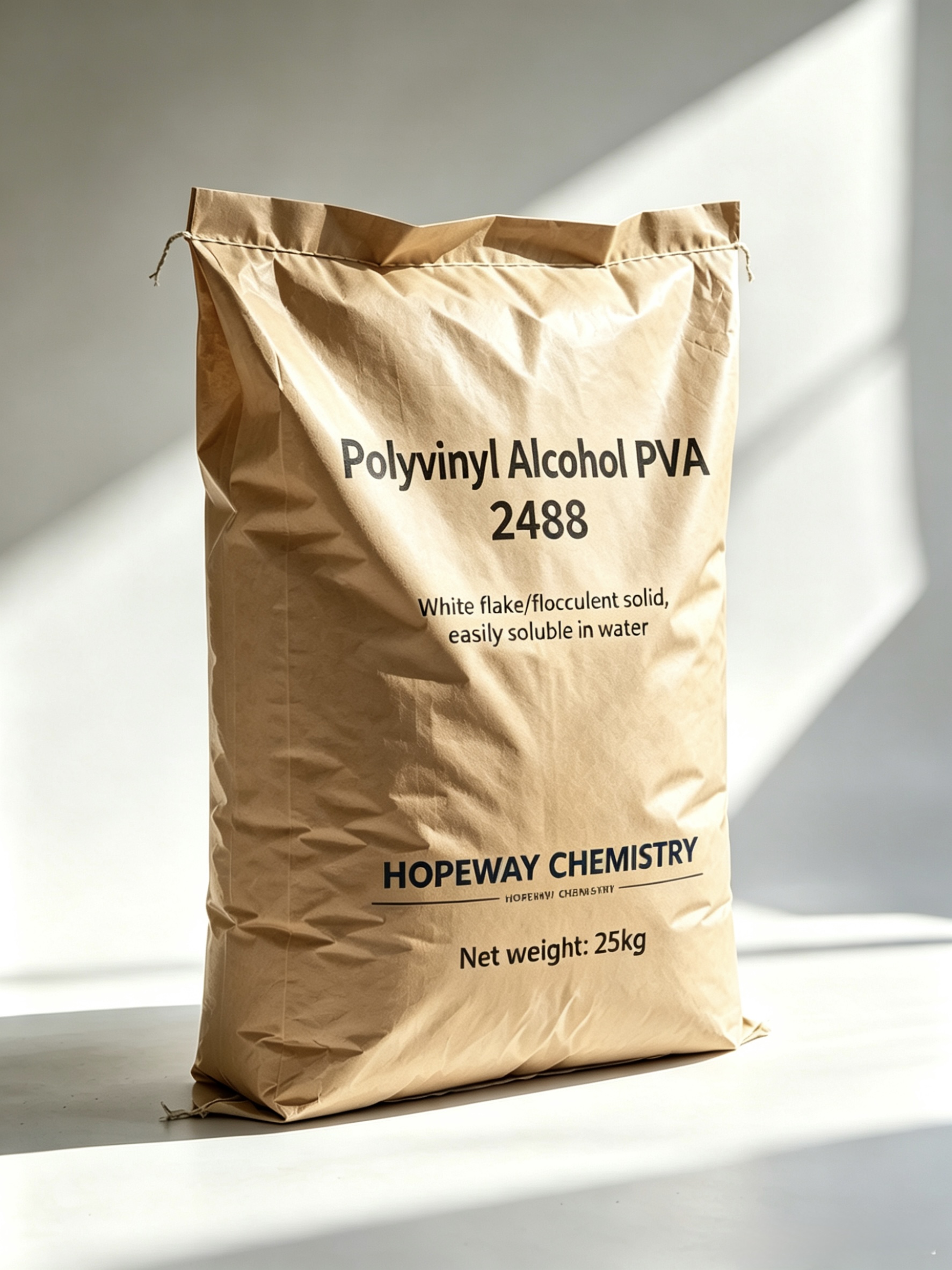
| PVA 2488 | Partially hydrolyzed | 87–89% | ≈2400 | 44–55 mPa·s | Cold water soluble | Exterior wall putty, tile adhesive, waterproof mortar, high-viscosity construction glue, wood adhesive, textile medium-high count warp sizing |
| PVA 2688 | Partially hydrolyzed | 87–89% | ≈2600 | 55–65 mPa·s | Water-soluble | High-solid construction glue, thick exterior coating, special carton adhesive, mineral binder |
| PVA 0599 | Fully hydrolyzed | 98–99% | ≈500 | 5–7 mPa·s | Water-soluble | Pharmaceutical coating, slow-release medical substrate, special acetal resin, fine chemical dispersant |
| PVA 1799 | Fully hydrolyzed | 98–99% | ≈1700 | 22–30 mPa·s | Dissolves in water above 80°C | Cotton and chemical fiber warp sizing, vinylon fiber spinning, oil well water shutoff agent, high-temperature adhesive, optical film raw material, water-resistant paper coating |
| PVA 2499 | Fully hydrolyzed | 98–99% | ≈2400 | 45–58 mPa·s | Hot water soluble | High-count/high-density fabric sizing, high-strength PVA fiber, PVB resin and film feedstock, water-resistant coating, cement reinforcing agent |
Step-by-Step Breakdown: How to Match a PVA Grade to Your Process
Step 1: Define the dissolution temperature window
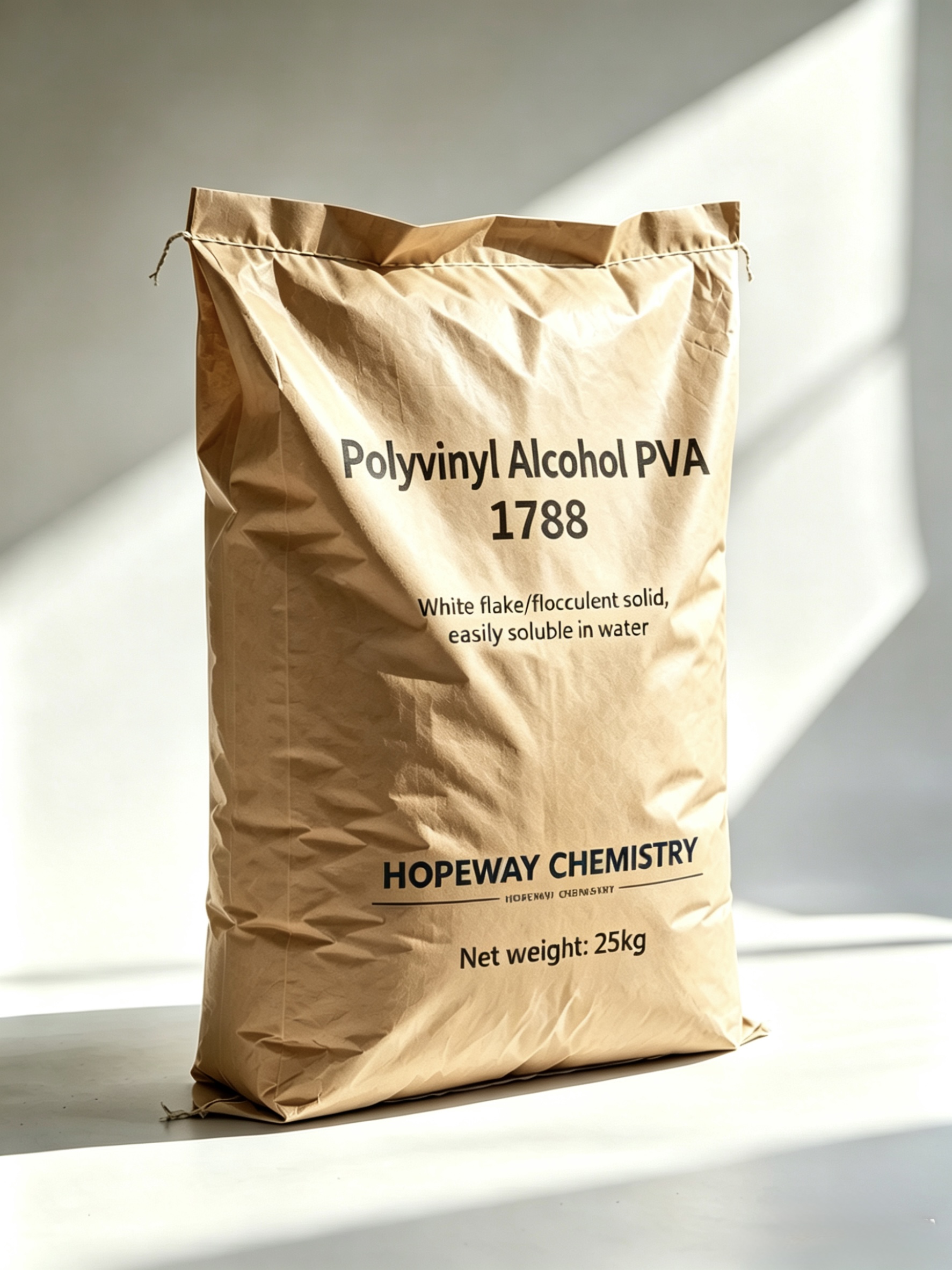
Cold-water mixing favors partially hydrolyzed PVA such as 1788 or 2488. Processes that can heat water above 80°C can also use fully hydrolyzed grades such as 1799 or 2499.
Step 2: Choose hydrolysis type by application chemistry
For cement-based systems, partially hydrolyzed PVA (1788/2488) is preferred because it is compatible with alkaline conditions. For water-resistant films and high-strength sizing, fully hydrolyzed PVA (1799/2499) is more suitable.
Step 3: Match viscosity and degree of polymerization
Low-viscosity formulations require low-DP grades like PVA 0588. Medium-viscosity construction glue and paper adhesives often use PVA 1788. High-viscosity adhesives, tile adhesives, and medium-high count warp sizing use PVA 2488 or PVA 2688.
Step 4: Check impurity and additive requirements
Construction putty requires low ash, low sodium acetate, and low moisture content to avoid efflorescence. Textile desizing waste should be biodegradable. For food-contact paper, buyers should request low-odor, indirect contact certified grades.
Step 5: Review supplier manufacturing and quality control
A professional PVA supplier should be able to provide complete testing documentation. HOPEWAY’s production system includes centralized laboratories, full-process inspection, and 100% product testing. Standard export documents include TDS, MSDS, and COA.
Step 6: Confirm customization, MOQ, and lead time
For OEM/ODM requirements, confirm whether the supplier can adjust mesh size, packaging, or specific viscosity and hydrolysis parameters. HOPEWAY supports customized mesh size, logo, and package, with a typical MOQ of 5 tons and lead time of 7–10 days.
Step 7: Validate with samples before bulk order
Run a formula trial with a small sample before committing to container quantities. This is also the moment to verify that the batch COA matches the agreed specification and that the product dissolves correctly in your equipment.
Use Cases by Industry
Adhesive industry
In adhesives, PVA acts as a film-former and thickener. PVA 2488 and PVA 2688 are used in high-solid construction glue, thick exterior coating, and special carton adhesives because of their high viscosity and strong adhesion. PVA 0588 is used as a protective colloid for VAE emulsion, while PVA 1788 is common in stationery glue and carton re-moistening adhesive.
Textile warp sizing
For cotton and chemical fiber warp sizing, PVA 1799 provides a uniform film, high abrasion resistance, and low ash. A large Indonesian textile mill has purchased 850 tons of PVA 1799 per year for more than two years, using 20GP containers on a monthly delivery schedule. The mill uses it on high-speed air jet looms, with custom mesh size from 120 to 250 mesh to match an automated continuous sizing line. Results included stable sizing, less yarn shedding, and lower fabric defect rates.
Paper coating and surface sizing
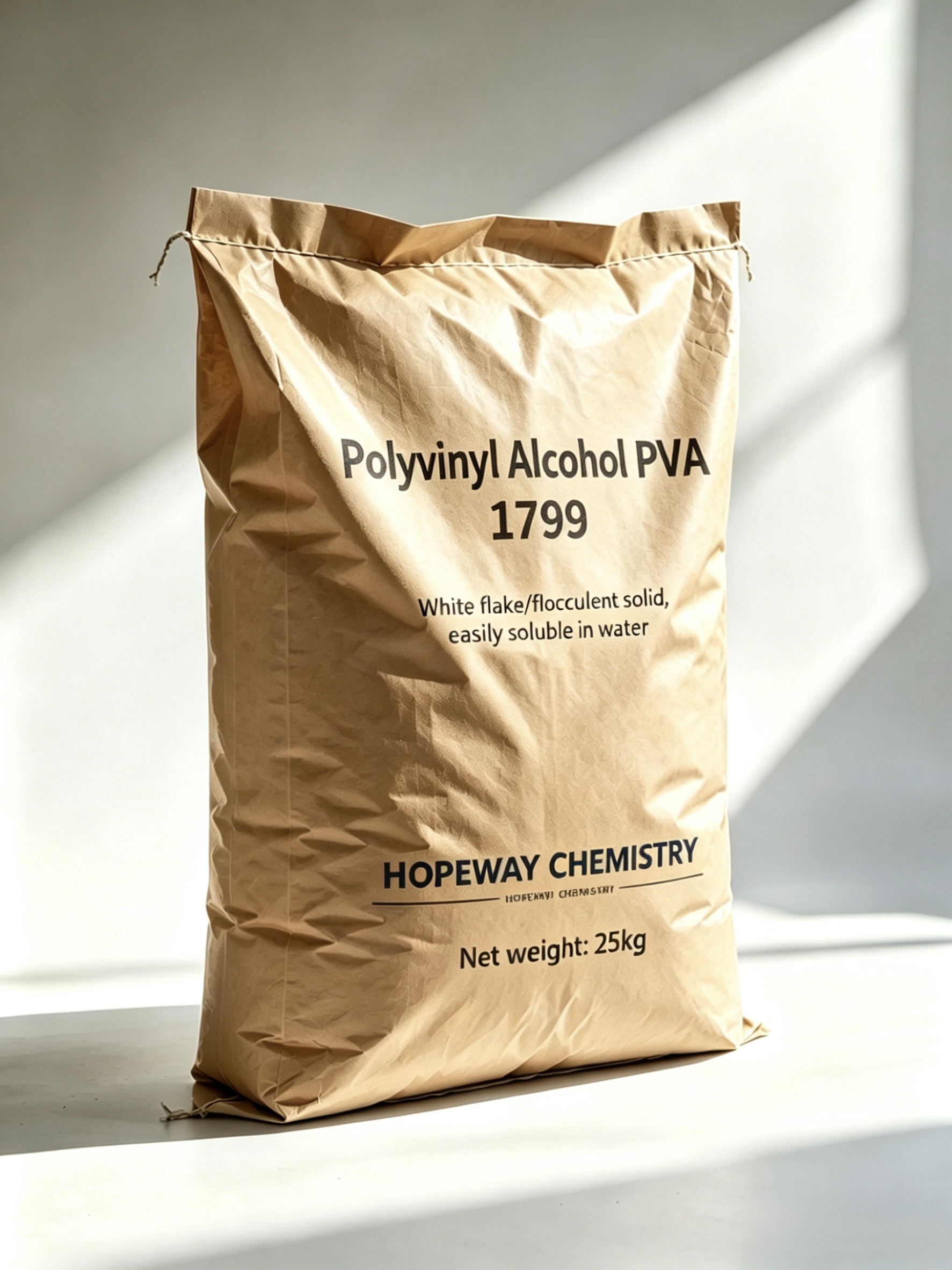
PVA 1788 is used for paper surface sizing and thermal paper coating, improving surface smoothness, printability, oil resistance, and tensile strength. PVA 1799 supports water-resistant paper coating and optical film raw material. PVA 2499 adds high-strength characteristics for demanding paper and cement reinforcing applications.
Construction
Partially hydrolyzed PVA 1788 and PVA 2488 are widely used in interior wall putty, tile adhesive, waterproof mortar, and construction glue. A construction chemical distributor in Brazil has purchased 1,120 tons of PVA 1788/2488 per year for more than two years. The distributor uses the grades for interior wall putty and repair mortar. Adjustable mesh size from 80 to 200 mesh allowed the material to feed automatically, while stable viscosity and low ash kept batch-to-batch consistency under high-temperature and humid conditions. Reported effects included improved adhesion, water resistance, crack resistance, and a reduction in finished product delamination and powder falling.
Biodegradable packaging films
PVA films are part of the growing water-soluble packaging segment, with the market expanding at a 7.1% CAGR between 2026 and 2034. Film producers need PVA grades with controlled dissolution temperature and molecular weight distribution. HOPEWAY’s integrated portfolio includes PVA optical film and PVB resin and film production, giving the company film-level polymer experience that can be applied to customized PVA film-grade development.
FAQ
What should I verify when evaluating ISO-certified professional PVA manufacturers?
Certification claims should be supported by documents. Request the certificate scope, a current COA, MSDS, and TDS for each lot. Confirm that the grade parameters—hydrolysis, viscosity, and mesh size—match your process. A professional supplier should provide 100% product testing, batch traceability, and technical support to answer dissolution or formulation questions.
What is the difference between partially and fully hydrolyzed PVA?
Partially hydrolyzed PVA (87–89%) is typically cold-water soluble and well suited to alkaline construction systems, adhesives, and paper sizing. Fully hydrolyzed PVA (98–99%) dissolves in hot water, and its higher crystallinity gives stronger film formation, water resistance, and tensile performance, which is useful for textile warp sizing and specialized coatings.
Which PVA grade should I choose for adhesives, textile sizing, paper coating, or construction?
For high-viscosity construction glue and wood adhesive, PVA 2488 or PVA 2688 are common. For cotton and chemical fiber warp sizing, PVA 1799 is typical. For paper surface sizing and thermal paper, PVA 1788 is widely used. For interior wall putty and tile adhesive, PVA 1788 and PVA 2488 are typical partially hydrolyzed choices. For low-viscosity formulations and protective colloid roles, PVA 0588 is recommended.
What MOQ and lead time can I expect from a professional PVA supplier?
A supplier with integrated production can support OEM/ODM customization, with a typical MOQ of 5 tons and lead time of 7–10 days. Before bulk ordering, request samples and technical documents so your formulation can be tested against the actual lot. HOPEWAY supports custom mesh size, viscosity, hydrolysis degree, and package design, and can arrange priority shipment for stock-holding clients. For a sample or specification consultation, contact the team or download the PVA catalogue below.
Get the PVA Catalogue
Download the HOPEWAY PVA catalogue for detailed specifications, applications, and shipment information.
Conclusion
Professional PVA selection is a constraint-driven process. Buyers need to verify the hydrolysis degree, viscosity range, solubility behavior, impurity profile, and supplier quality controls before scaling up. The seven HOPEWAY grades described in this article cover the main application needs across adhesives, textile sizing, paper coating, construction, and film development. Combined with integrated production, 100% product testing, and after-sales technical support, this specification reference can serve as a practical starting point for evaluation.
HOPEWAY CHEMICAL INDUSTRIAL CO., LIMITED, founded in 1998, is an integrated PVA manufacturer and exporter based in Xiamen, China. The company operates standardized production bases, employs 4,451 people, and supplies PVA to more than 40 countries and regions. Export documentation, sample service, and technical consultation are available to support procurement decisions.
Need help matching a PVA grade to your process? Contact Kelvin at kelvin@xmhwchem.com or WhatsApp +86 158-8028-4585.
Have Questions or Need More Details?
Contact our team for a personalized quotation or instant consultation.
Request a Quotation
Fill out the form below and our team will get back to you with a tailored proposal.
WhatsApp Direct Chat
Prefer to chat in real-time? Message us on WhatsApp for instant assistance & quick answers.
- Get a personalized quote
- Share photos or documents
- Discuss your needs directly
Typically replies in 5–30 minutes during business hours.