PVA in Biotech & Medical Prototyping: Selecting Water-Soluble Polymer Substrates and Film Carriers
PVA in Biotech & Medical Prototyping: Selecting Water-Soluble Polymer Substrates and Film Carriers
A biotech or medical prototyping project that needs a water-soluble polymer substrate or a film carrier usually arrives at the same decision point: which professional polyvinyl alcohol (PVA) grade will cast a usable film, release or dissolve at the right stage of the prototype, and fit the dissolution and coating setup already available on the bench or in the pilot line. This guide is written for that decision. It maps four common prototyping scenarios to specific listed grades, using only confirmed product data and application facts, and it explains which questions a supplier must be able to answer before a prototype can move to scale-up.
Why Industrial PVA Specifications Do Not Answer Prototyping Questions
Polyvinyl alcohol literature is normally organized around production lines rather than around experiments. A textile sizing datasheet explains how a grade behaves in a sizing tank at 80–95 °C on a continuous line. A construction datasheet explains how a partially hydrolyzed powder behaves inside a dry-mix mortar system. Neither format answers what a prototyping team needs to know before it commits a week of bench time.
Those unanswered questions are consistent across projects:
- Will the grade cast a continuous film that survives handling, winding or lamination during prototyping?
- What triggers dissolution — cold water, or water above 80 °C?
- Does the solution viscosity suit a casting knife, a spray system, or a dip bath?
- Can the grade be supplied as a small trial quantity before a bulk commitment?
PVA itself does not change from grade to grade in its basic nature. It is produced by alcoholysis of polyvinyl acetate (PVAc) and is supplied as a water-soluble polymer in white powder or flake form, characterized by film-forming behaviour, strong adhesion and non-toxicity. What changes across the portfolio is the combination of three parameters: degree of polymerization (DP), degree of hydrolysis, and the solution viscosity that results from both. That combination determines whether a grade behaves as a thin coating layer, a handleable film carrier, or a temporary support that disappears in cold water.
The practical consequence: selecting “general purpose PVA” collapses three different projects into one specification. A slow-release substrate project, a cast-film carrier project and a cold-water-soluble temporary carrier project each require a different grade profile, even when all three end up buying from the same supplier.
The 2026 Context: Market Growth, Cost Pass-Through, and Why Specialty Grades Stay Available
Three market-level facts shape how a prototyping buyer should approach PVA sourcing in the current cycle.
Market size depends on how the boundary is drawn. Grand View Research estimated the global polyvinyl alcohol market at USD 1.21 billion in 2025, projecting USD 1.66 billion by 2033. Other commercial publishers report materially larger figures for the same period, and the difference comes mainly from whether PVA fibers and fully converted downstream films are counted inside the market. The usable takeaway for a buyer is that market-size headlines are not a grade-selection input — the specification is. A headline figure also says nothing about whether the narrow grade a prototype needs is in production.
Upstream cost volatility passes through to PVA pricing. In March 2026, Anhui Wanwei High-Tech Material Industry Co., Ltd. raised prices on all PVA products by 2,000 Yuan per ton, citing rising upstream costs. That adjustment reflects the cost of vinyl acetate monomer feeding into PVA polymerization. For a prototyping budget, the implication is simple: lock sample and pilot quantities early, and treat quoted price windows as short-lived. For teams moving toward scale-up, it is a reason to discuss fixed-window or index-linked contract terms rather than accepting open-ended pricing.
Specialty grades are available because a large industrial base supports them. PVA’s main volume applications — adhesives, textile sizing agents, paper coating, construction additives and biodegradable packing films — keep a broad grade portfolio in continuous polymerization and alcoholysis. Low-viscosity coating grades and high-DP film grades exist commercially because the same production infrastructure serves the high-volume markets. HOPEWAY CHEMICAL INDUSTRIAL CO., LIMITED is a China-based manufacturer and exporter of polyvinyl alcohol, VAE emulsion, redispersible polymer powder, PVA film and PVA fiber, founded in 1998, with an annual PVA production capacity of 350,000 metric tons. That capacity base is what allows a specialty grade to be sampled at pilot scale while container-scale supply remains available later.
Medical and biotech prototyping adds one dimension that commodity PVA purchasing does not: documentation. Applications such as non-woven fabric binders for medical masks and disposable gowns specify ultra-low heavy metal content, formaldehyde-free formulation and conformity with medical hygiene certification requirements. Those requirements belong to the finished application and the downstream regulatory pathway, so the buyer’s task is to obtain the technical documents — TDS, MSDS and COA — that a regulatory review will eventually request, and to confirm that the grade selected is the grade documented.
Matching a Prototyping Function to a Listed Grade
Start by naming the role the polymer plays
Before comparing grades, reduce the prototype to one of three polymer roles. Most biotech and medical prototyping projects fall into one of them, and the role determines which parameters matter.
- Coating or slow-release substrate. The polymer is part of a coating layer or matrix that controls how an active substance is protected or released. Uniformity of the applied layer matters more than mechanical strength, so low viscosity and low DP are usually the starting profile.
- Film carrier. The polymer is cast, dried and handled as a film, or becomes a structural element of a device prototype. Higher DP and higher viscosity produce a more cohesive cast film that can be handled, wound or laminated.
- Temporary water-soluble carrier. The film or coating must disappear completely at a defined step. Here the dissolution trigger — cold water versus hot water — becomes the primary selection criterion, ahead of film strength.
PVA 0599: low-viscosity fully hydrolyzed grade for coating and slow-release substrate work
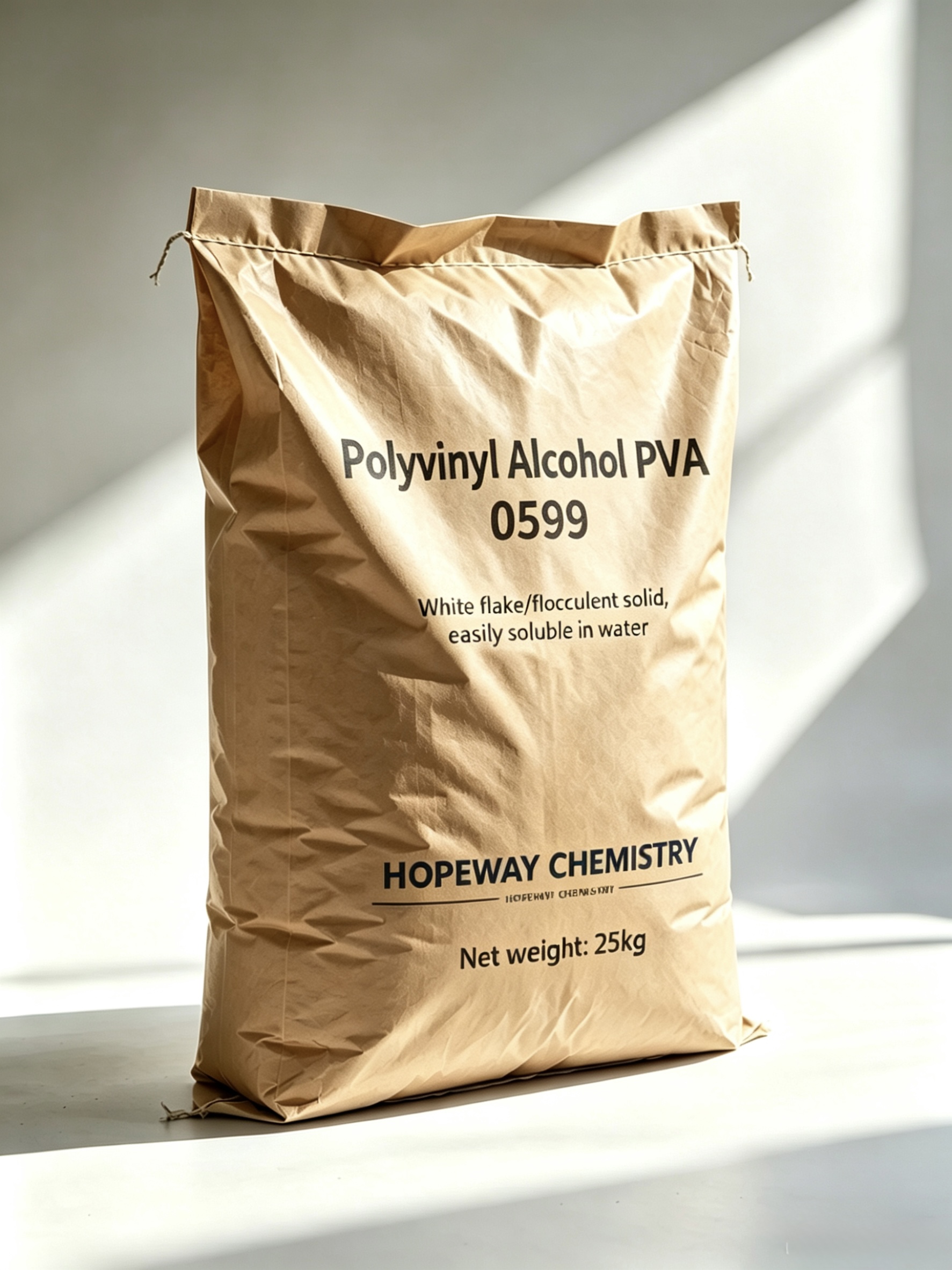
PVA 0599 is a fully hydrolyzed grade with a degree of polymerization of approximately 500, a degree of hydrolysis of 98–99% and a viscosity of 5–7 mPa·s. Its listed application areas are pharmaceutical coating, slow-release medical substrate, special acetal resin and fine chemical dispersant.
For a project in which a fully hydrolyzed solution has to be applied as a thin, uniform layer — the standard starting point for slow-release substrate experiments — this is the grade the product data points to. The low DP keeps solution viscosity low, which is the property that matters when coating uniformity, not film strength, is the objective. The same low-viscosity profile also makes the grade easier to pump, filter and spray at the bench stage.
PVA2499: high-DP fully hydrolyzed grade for film carriers and PVB film routes
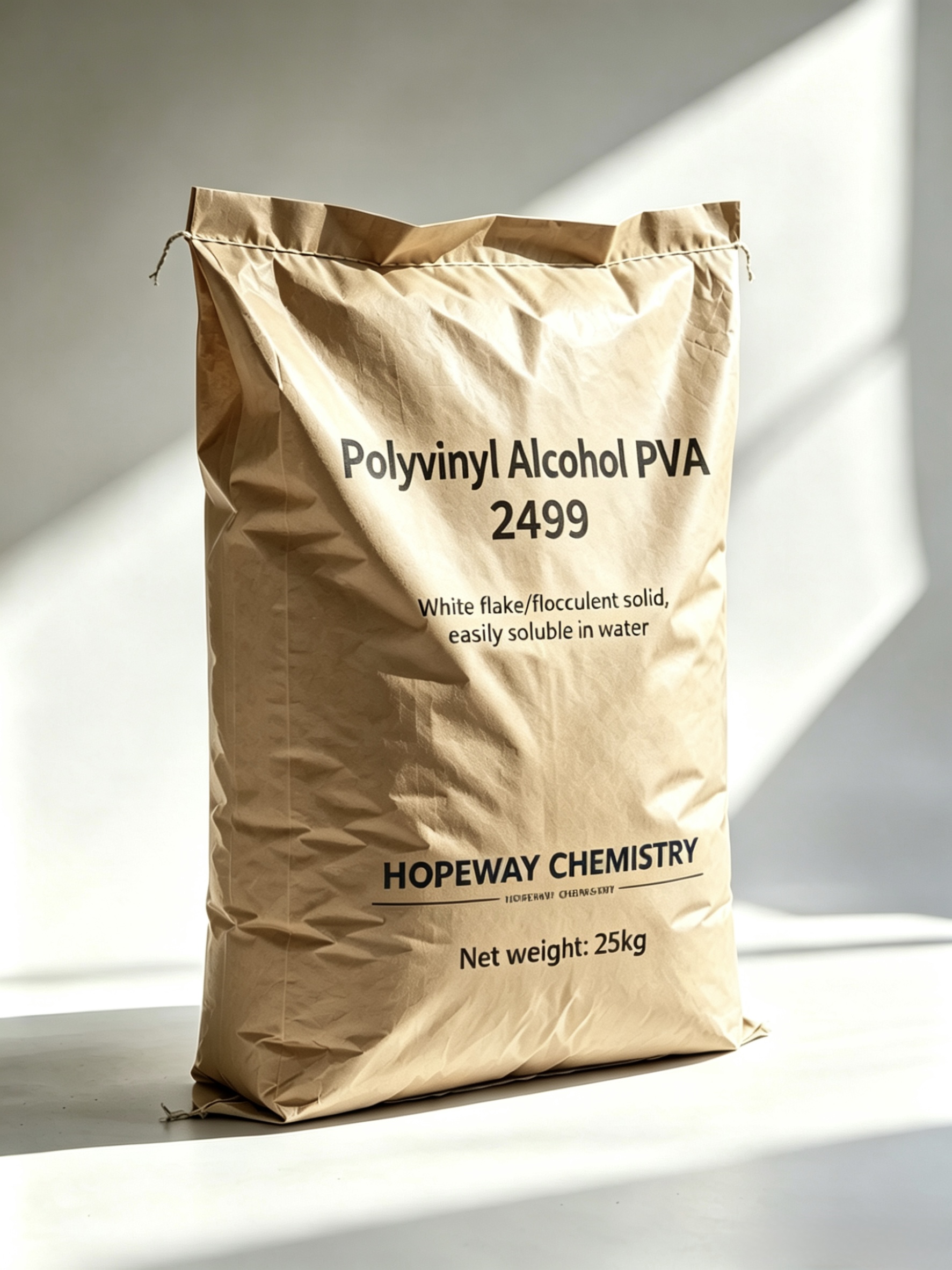
PVA2499 is a fully hydrolyzed grade with a degree of polymerization of approximately 2400, a degree of hydrolysis of 98–99% and a viscosity of 45–58 mPa·s. It is supplied as a hot-water-soluble product. Its listed application areas include high-count and high-density fabric sizing, high-strength PVA fiber, raw material for PVB resin and film for automotive and photovoltaic use, water-resistant coating, and cement reinforcing agent.
In prototyping terms, PVA2499 is the film-forming workhorse of the portfolio. It combines the highest DP and viscosity of the fully hydrolyzed grades with hot water solubility, which means a cast film built from it has more polymer chain length behind it than a low-DP coating grade. Two scenarios follow directly from the listed applications:
- A prototype that needs a water-processable carrier film with enough integrity to be handled, wound or laminated during development.
- A project heading toward PVB resin and film work, where PVA2499 is listed as the raw material route rather than as an end-use additive.
Because the grade is specified as hot water soluble, dissolution planning must include a heated stage. A team that assumes room-temperature dissolution for PVA2499 will lose bench time to undissolved flake rather than to polymer performance.
PVA1799: the mid-range fully hydrolyzed option
PVA1799 sits between the two fully hydrolyzed grades above, with a degree of polymerization of approximately 1700, hydrolysis of 98–99% and a viscosity of 22–30 mPa·s. It dissolves in water above 80 °C. Its listed applications are cotton and chemical fiber warp sizing, vinylon fiber spinning, oil well water shutoff agent, high-temperature industrial adhesive, raw material for optical film and water-resistant paper coating. For prototyping purposes, it represents a middle viscosity point where a slightly stronger film than PVA 0599 is needed but the high viscosity of PVA2499 is not required.
Cold-water-soluble partially hydrolyzed grades: 0588, 1788, 2488, 2688
The partially hydrolyzed polyvinyl alcohol grades are specified at 87–89% hydrolysis and are cold water soluble. They cover a range of DP and viscosity, and each carries its own listed application profile.

- PVA 0588 — DP ≈500, viscosity 4.5–6.0 mPa·s, cold water soluble. Listed applications include cosmetic thickener, water-soluble agricultural seed coating, printing wetting agent, protective colloid for VAE emulsion, low-viscosity glue and ink coating. It is also the grade named in the medical non-woven binder scenario for masks and disposable gowns.
- PVA 1788 — DP ≈1700, viscosity 20.5–28 mPa·s, cold water soluble. Listed for construction glue and putty, dry mortar additive, paper surface sizing, paper adhesive, thermal paper coating, screen printing, ceramic binder and water treatment flocculant.
- PVA 2488 — DP ≈2400, viscosity 44–55 mPa·s, cold water soluble. Listed for exterior wall putty, tile adhesive, waterproof mortar, high-viscosity construction glue, thick coating, wood adhesive and textile medium-to-high count warp sizing. Its published specification of 87.0–89.0% hydrolysis and 44.0–55.9 mPa·s for a 4% aqueous solution at 20 °C is consistent with the grade data.
- PVA2688 — DP ≈2600, viscosity 55–65 mPa·s, cold water soluble. Listed for high-solid construction glue, thick exterior coating, special carton adhesive and mineral binder.
The selection rule inside this group is straightforward: the higher the DP, the higher the viscosity and the stronger the film, but the longer and more demanding the dissolution step. For a temporary carrier that must vanish in a cold-water wash at the end of a prototyping sequence, a cold-water-soluble partially hydrolyzed grade removes an entire heated process step from the workflow.
What the supplier side has to provide
Grade selection is only half of a prototyping decision. The other half is whether the supplier can support a project at a scale that does not yet justify a container order. HOPEWAY operates as an OEM/ODM-capable manufacturer with customization of mesh size, logo and packaging, a monthly capacity of 300,000 tons, a minimum order quantity of 5 tons, a lead time of 7–10 days and 100% testing. Sample service is available so that a formula can be trialled before a bulk order, and mesh size, viscosity and hydrolysis degree can be adjusted to the customer’s requirement.
Equally important for medical-adjacent work, the documentation set — TDS, MSDS and COA — is issued for customs clearance and inspection, and full-process quality inspection with third-party test reports is part of the standard supply package. For a prototyping team that will eventually need to hand documents to a regulatory or quality reviewer, choosing a polyvinyl alcohol supplier in China that can issue this set on request avoids a re-sourcing exercise later.
Step-by-Step: From Project Scenario to a Validated Grade
- Write the functional requirement in three sentences. What must dissolve or release, at which step, and into what medium. If the answer to the third question is “cold water at the end of the run”, the selection is already narrowed to partially hydrolyzed grades. If it is “a heated extraction step”, a fully hydrolyzed grade remains in scope.
- Fix the dissolution trigger before comparing anything else. Cold water solubility is specified for 0588, 1788, 2488 and 2688. PVA1799 requires water above 80 °C, and PVA2499 is specified as hot water soluble. PVA 0599 is listed for pharmaceutical coating and slow-release substrate, where the coating step rather than the film dissolution usually sets the process temperature.
- Match viscosity to the application method. A spray or thin-layer coating step tolerates the low viscosity of PVA 0599 (5–7 mPa·s) or PVA 0588 (4.5–6.0 mPa·s). A casting or thick-layer step suits the higher viscosity of PVA 2488 (44–55 mPa·s), PVA2688 (55–65 mPa·s) or PVA2499 (45–58 mPa·s). A 4% solution at 20 °C is the reference condition on which the PVA 2488 figure is published.
- Check the downstream chemistry, not just the film. If the programme is heading toward PVB resin or film, PVA2499 is the listed raw material grade. If the programme involves pharmaceutical coating or slow-release substrate formulation, PVA 0599 is the listed grade. If the programme is a non-woven medical prototype, PVA 0588 is the grade named in that application.
- Confirm the documentation requirement early. Medical non-woven applications specify ultra-low heavy metal content, formaldehyde-free formulation and conformity with medical hygiene certification. Confirm which of those requirements apply to your prototype and request TDS, MSDS and COA before the first trial run rather than after it.
- Validate with a sample before specifying. Small test samples are available for formula trials ahead of a bulk order, and mesh size, viscosity and hydrolysis degree can be customized. A trial at 5 kg scale answers questions that a datasheet cannot.
- Lock the supply parameters. Minimum order quantity is 5 tons, standard lead time is 7–10 days, and monthly capacity is 300,000 tons with 100% testing. Packaging, logo and mesh size are customizable under the OEM/ODM arrangement. Free technical guidance on dissolution process, application formula and production parameter adjustment is part of the support package, including online video consultation during the pilot stage.
Four Prototyping Scenarios, Mapped to Grades
Scenario 1: Slow-release substrate feasibility work
The project needs a fully hydrolyzed polymer that can be applied as a thin, uniform layer over a substrate while a release behaviour is characterized. Listed grade: PVA 0599 — fully hydrolyzed, DP ≈500, hydrolysis 98–99%, viscosity 5–7 mPa·s, with pharmaceutical coating and slow-release medical substrate among its listed applications. The low viscosity supports uniform application; the fully hydrolyzed character matches the acetal and coating chemistry route.
Scenario 2: Cast film carrier for a device prototype
The project needs a film that can be cast, dried, removed from the plate and handled — possibly laminated — during prototype assembly. Listed grade: PVA2499 — DP ≈2400, viscosity 45–58 mPa·s, hot water soluble, listed as raw material for PVB resin and film. The high DP and viscosity give the cast film more body, and the PVB route makes the same grade usable if the programme later shifts toward resin or film development.
Scenario 3: Temporary carrier that must dissolve in a cold-water step
The project needs a support film or coating that is removed in a cold rinse without heating the prototype. Listed grade candidates: PVA 0588 (DP ≈500, viscosity 4.5–6.0 mPa·s), PVA 1788 (DP ≈1700, viscosity 20.5–28 mPa·s), PVA 2488 (DP ≈2400, viscosity 44–55 mPa·s) or PVA2688 (DP ≈2600, viscosity 55–65 mPa·s), all partially hydrolyzed at 87–89% and cold water soluble. Choose the lowest viscosity that still gives a handleable film; increasing DP adds strength but lengthens the dissolution step.
Scenario 4: Medical non-woven prototype (mask or gown structure)
The project needs a binder that bonds a fiber web and improves fabric tensile strength. Listed grade: PVA 0588 used as a cold-soluble aqueous solution spray-coated onto the fiber web, then dried. The application is specified as non-toxic and skin-friendly, and its special requirements are ultra-low heavy metal content, formaldehyde-free formulation and conformity with medical hygiene certification. Supporting equipment in that scenario includes a non-woven spunlace machine, a spray sizing system and a tunnel drying oven operating at 100–130 °C. For a textually adjacent benchmark, the same cold-soluble route is used in paper and packaging work with PVA 1788 applied by an online sizing machine and dried at 90–120 °C — a useful reference point when a prototype involves a continuous web.
Grade Comparison for Prototyping Selection
| Grade | Type | Degree of Polymerization | Hydrolysis | Viscosity | Solubility | Listed application relevance |
|---|---|---|---|---|---|---|
| PVA 0599 | Fully hydrolyzed | ≈500 | 98–99% | 5–7 mPa·s | Not specified as cold water soluble | Pharmaceutical coating; slow-release medical substrate; special acetal resin; fine chemical dispersant |
| PVA 0588 | Partially hydrolyzed | ≈500 | 87–89% | 4.5–6.0 mPa·s | Cold water soluble | Protective colloid for VAE emulsion; low-viscosity glue; ink coating; medical non-woven binder scenario |
| PVA 1788 | Partially hydrolyzed | ≈1700 | 87–89% | 20.5–28 mPa·s | Cold water soluble | Paper surface sizing; paper adhesive; thermal paper coating; construction glue |
| PVA1799 | Fully hydrolyzed | ≈1700 | 98–99% | 22–30 mPa·s | Dissolves in water above 80 °C | High-temperature industrial adhesive; optical film raw material; water-resistant paper coating |
| PVA 2488 | Partially hydrolyzed | ≈2400 | 87–89% | 44–55 mPa·s | Cold water soluble | High-viscosity glue; thick coating; wood adhesive; published spec 87.0–89.0% and 44.0–55.9 mPa·s at 4%, 20 °C |
| PVA2499 | Fully hydrolyzed | ≈2400 | 98–99% | 45–58 mPa·s | Hot water soluble | Raw material for PVB resin and film; high-strength PVA fiber; water-resistant coating |
| PVA2688 | Partially hydrolyzed | ≈2600 | 87–89% | 55–65 mPa·s | Cold water soluble | High-solid construction glue; thick exterior coating; special carton adhesive; mineral binder |
FAQ: Water-Soluble PVA Substrates and Film Carriers
1. Are these PVA grades suitable for pharmaceutical or medical-contact prototyping?
The product data lists PVA 0599 for pharmaceutical coating and slow-release medical substrate, and PVA 0588 appears in the medical non-woven binder scenario for masks and disposable gowns. That scenario specifies non-toxicity and skin-friendliness along with ultra-low heavy metal content, formaldehyde-free formulation and conformity with medical hygiene certification requirements. Final suitability depends on the finished prototype and the applicable regulatory pathway, so the documentation set — TDS, MSDS and COA, plus third-party test reports — should be requested and reviewed against your own compliance criteria.
2. Which grade should be used for a slow-release substrate and which for a film carrier?
For slow-release substrate or coating work, PVA 0599 is the listed grade: fully hydrolyzed, DP ≈500, hydrolysis 98–99%, viscosity 5–7 mPa·s. For a cast film carrier that must be handled or laminated, PVA2499 is the listed grade: fully hydrolyzed, DP ≈2400, viscosity 45–58 mPa·s, hot water soluble and specified as raw material for PVB resin and film. The distinction is deliberate — low viscosity favours uniform coating, high viscosity favours film cohesion.
3. What drives the cost side of a PVA prototyping budget?
PVA pricing follows upstream cost movement. In March 2026, Anhui Wanwei High-Tech Material Industry Co., Ltd. raised prices on all PVA products by 2,000 Yuan per ton, citing rising upstream costs. Because PVA is polymerized from vinyl acetate monomer, feedstock movement reaches PVA prices. On the market side, Grand View Research estimated the global PVA market at USD 1.21 billion in 2025 with a projection of USD 1.66 billion by 2033, although other publishers report larger figures depending on whether PVA fibers and converted films are included. For budgeting, the practical controls are sample-stage validation before bulk ordering, a defined MOQ of 5 tons, and short quoted validity windows.
4. Can I obtain a sample before placing a bulk order?
Yes. Small test samples are available for formula trials before a bulk order, and mesh size, viscosity and hydrolysis degree can be customized to your requirement. Sample-stage trials are the appropriate place to confirm dissolution behaviour, film handling and coating uniformity, because those properties depend on your process conditions rather than on the grade data alone.
5. What are the lead time and supply terms for moving from prototype to production?
Minimum order quantity is 5 tons, standard lead time is 7–10 days, monthly capacity is 300,000 tons, and quality control is 100% testing. Packaging, logo and mesh size are customizable under the OEM/ODM arrangement, and the export documentation set includes COA, TDS and MSDS. Free technical guidance covers dissolution process, application formula and production parameter adjustment, with online video consultation available during scale-up. To move forward, you can request a sample or a quotation through the technical contact listed below, or review the full product range in the HOPEWAY PVA catalogue.
Conclusion
Selecting a water-soluble polymer substrate or film carrier for a biotech or medical prototyping project comes down to three decisions made in a fixed order: the role the polymer plays, the dissolution trigger, and the viscosity the application method can tolerate. PVA 0599 covers low-viscosity fully hydrolyzed coating and slow-release substrate work. PVA2499 covers high-DP hot-water-soluble film carriers and the PVB film raw material route. PVA1799 sits between them. The partially hydrolyzed grades — 0588, 1788, 2488 and 2688 — cover the cold-water-soluble temporary carrier case, with the lowest viscosity that still produces a handleable film being the correct starting point.
Because all of these grades are supported by a production base with an annual PVA capacity of 350,000 metric tons, a prototyping team is not forced to choose between a sample-sized trial and a container-sized commitment. The sequence that works is sample first, technical guidance during dissolution and trial runs, then defined supply terms at 5 tons MOQ with a 7–10 day lead time.
Next Step: Match a Grade to Your Prototype
Send the functional requirement — what dissolves, at which step, and into what medium — and HOPEWAY can confirm the grade, the mesh size and the viscosity setting for a sample trial. Technical guidance on dissolution process and application formula is provided free of charge, with online video consultation available during the trial.
Contact: Kelvin — kelvin@xmhwchem.com · WhatsApp: +86 158-8028-4585 · Website: www.xmhwchem.com · Download the PVA catalogue (PDF)
HOPEWAY CHEMICAL INDUSTRIAL CO., LIMITED — polyvinyl alcohol, VAE emulsion, redispersible polymer powder, PVA film and PVA fiber. Address: Rongqiao gongguan, Haicang district, Xiamen, Fujian province, China.
Have Questions or Need More Details?
Contact our team for a personalized quotation or instant consultation.
Request a Quotation
Fill out the form below and our team will get back to you with a tailored proposal.
WhatsApp Direct Chat
Prefer to chat in real-time? Message us on WhatsApp for instant assistance & quick answers.
- Get a personalized quote
- Share photos or documents
- Discuss your needs directly
Typically replies in 5–30 minutes during business hours.