
Professional PVA for Slow-Release Medical Substrates & Water-Resistant Coatings
Professional PVA for Slow-Release Medical Substrates & Water-Resistant Coatings
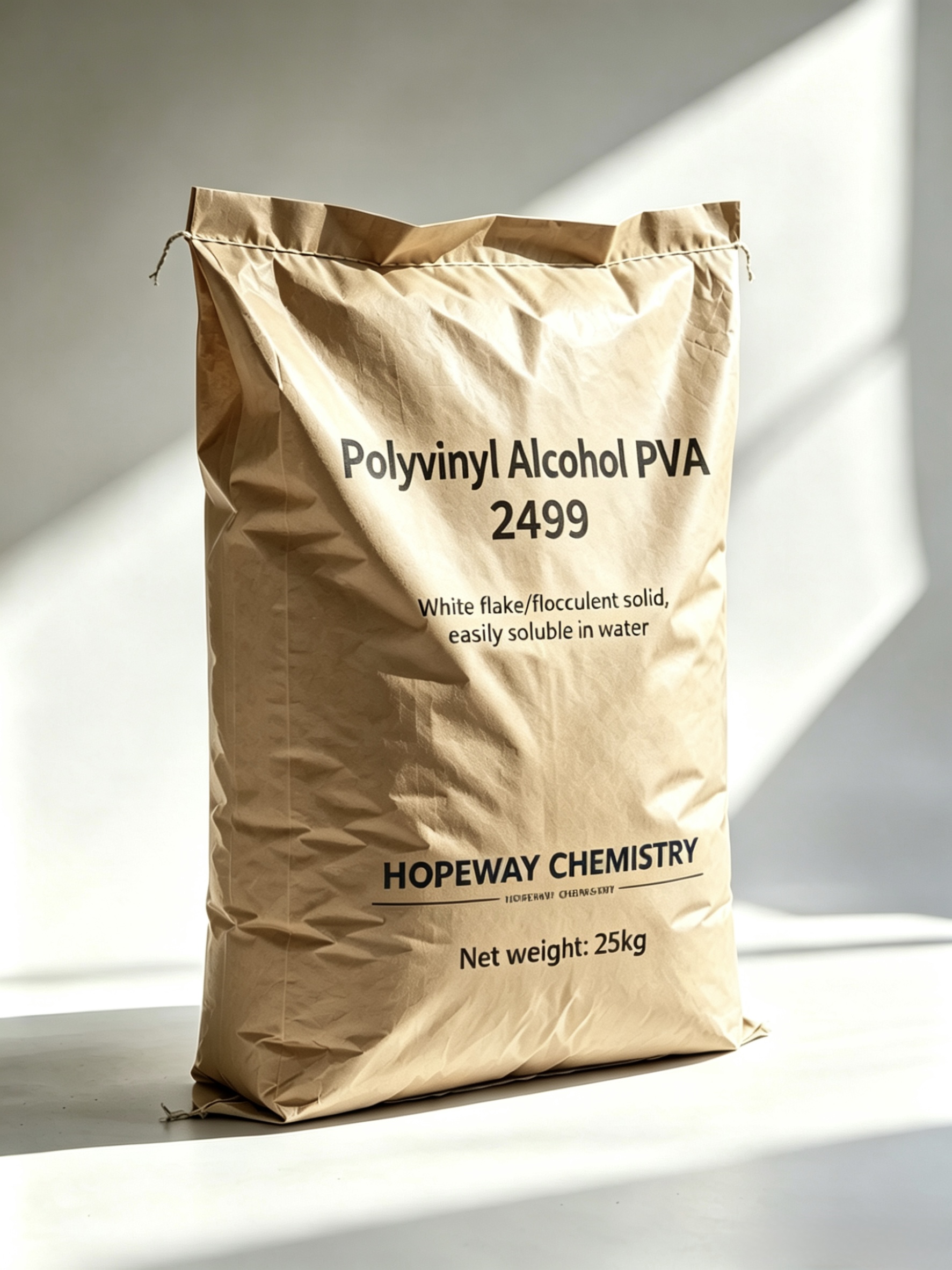
Short answer: in the supplied HOPEWAY grade data, the slow-release medical substrate route and the water-resistant coating route split along three parameters that move together — degree of hydrolysis, degree of polymerization (DP) and the resulting solution viscosity. PVA 0599 (DP ≈ 500; hydrolysis 98–99%; viscosity 5–7 mPa·s) is the only grade whose documented application list names pharmaceutical coating and slow-release medical substrate. PVA2499 (DP ≈ 2400; 98–99%; 45–58 mPa·s; hot water soluble) is the higher-DP, higher-viscosity film-matrix option and is listed for water-resistant coating. PVA1799 (DP ≈ 1700; 22–30 mPa·s; dissolves above 80 °C) is the intermediate fully hydrolyzed choice, including water-resistant paper coating. When the process cannot work above 80 °C, the partially hydrolyzed 87–89% grades — PVA 1788, PVA 2488 and PVA 0588 — are the practical options. Where a ready-to-use liquid binder is preferable to powder dissolution, VAE 705, 706, 707 and 707H emulsions use polyvinyl alcohol as protective colloid and stabilizer.
The company behind these grades, HOPEWAY CHEMICAL INDUSTRIAL CO., LIMITED, is a Chinese manufacturer and exporter of polyvinyl alcohol (PVA), VAE emulsion, redispersible polymer powder (RDP), PVA film and PVA fiber, founded in 1998 and operating four production bases. Its stated PVA capacity is 350,000 metric tons per year, with 140,000 metric tons per year of VAE emulsion capacity and 731 R&D staff. Those numbers matter less to a formulation scientist than the grade-level data does, but they explain why a single supplier can cover a project that starts with a powder grade and later moves to an emulsion.
Why these two scenarios pull grade selection in opposite directions
A slow-release medical substrate and a water-resistant coating both need a coherent PVA film, and that is where the similarity ends. The substrate application needs the polymer to form a matrix that can be processed in water, hold its structure through coating and drying, and then behave predictably in the release environment. The coating application needs the film to resist re-dissolution when it meets water after curing. Those two requirements push hydrolysis in the same direction — up — but they push processing temperature in the opposite direction from what many R&D benches can actually deliver.
Three conflicts define the project:
- Water resistance versus processing window. The fully hydrolyzed 98–99% grades in this range require hot water: PVA2499 is described as hot water soluble, and PVA1799 is specified as dissolving in water above 80 °C. The 87–89% partially hydrolyzed grades in the same catalogue — PVA 1788 and PVA 2488 — are both described as cold water soluble.
- Film strength versus coating uniformity. Within the fully hydrolyzed family, the listed grades run from 5–7 mPa·s at DP ≈ 500 (PVA 0599) to 45–58 mPa·s at DP ≈ 2400 (PVA2499). Higher DP and higher viscosity support a stronger, more coherent matrix, but a thicker coating liquor is harder to apply as a thin, uniform film.
- Heat-sensitive components versus dissolution temperature. If the active ingredient, the substrate carrier or the plant itself cannot tolerate a hot dissolution step, a fully hydrolyzed grade is not a realistic starting point regardless of its dry-film performance.
Framing the decision as "which PVA is best" produces a dead end. The workable framing is: what must the substrate do, what temperature and equipment can the plant actually provide, and which grade satisfies both without an unverified assumption in between.
Industry background: what the grade data does and does not cover
Polyvinyl alcohol is manufactured by alcoholysis of polyvinyl acetate (PVAc). It is a water-soluble polymer supplied as white powder or flake, and the supplied technical description highlights film-forming performance, adhesion and non-toxicity. HOPEWAY's stated range covers partial and fully hydrolyzed grades — 1788, 2488, 0588, a low-temperature water-soluble grade, a textile sizing grade, and a pharmaceutical and food contact grade — alongside VAE copolymer emulsion, RDP, PVB resin and film, optical film and PVA fiber.
Market context is useful but should not drive a grade decision. Grand View Research estimated the global PVA market at USD 1.21 billion in 2025, projecting USD 1.66 billion by 2033. Published estimates for this polymer vary widely by scope, because some publishers include downstream films and fibers while others count resin only, so treat any single figure as a definition-dependent estimate rather than a settled number.
The medical-adjacent part of the project adds a documentation layer that has nothing to do with market size. Company-level environmental credentials — HOPEWAY states compliance with EU EPD, ISCC and EcoVadis standards — describe environmental performance, not product-level medical clearance. What a substrate team actually needs is grade-specific material documentation: TDS, MSDS, COA and third-party test reports, which the company states it provides for customs clearance, inspection and customer qualification.
Grade attributes that decide the outcome
Hydrolysis degree is the water-resistance lever
The catalogue splits cleanly at 87–89% and 98–99%. The fully hydrolyzed grades carry the water-contact applications: PVA2499 is listed for water-resistant coating, and PVA1799 for water-resistant paper coating alongside high-temperature industrial adhesive and optical film raw material. The partially hydrolyzed 87–89% grades carry the mild-processing applications: PVA 1788 for paper surface sizing, thermal paper coating and carton re-moistening adhesive; PVA 2488 for waterproof mortar, thick coating and wood adhesive. The pattern in the data is consistent — higher hydrolysis is listed where the dry film meets water, lower hydrolysis is listed where the polymer must dissolve easily and stay soluble.
The underlying mechanism is standard polymer behaviour: partially hydrolyzed PVA retains acetate groups that increase water sensitivity and lower the temperature needed to dissolve the resin. That is why a 87–89% grade opens at low temperature and why it is a weaker barrier once dried. Neither family is universally better; the substrate defines which side of the trade you can accept.
DP and viscosity set the film matrix and the coating rheology
Within each hydrolysis family, the listed data pairs higher DP with higher stated viscosity. In the fully hydrolyzed set: PVA 0599 at DP ≈ 500 gives 5–7 mPa·s, PVA1799 at DP ≈ 1700 gives 22–30 mPa·s, and PVA2499 at DP ≈ 2400 gives 45–58 mPa·s. In the partially hydrolyzed set: PVA 1788 at DP ≈ 1700 gives 20.5–28 mPa·s, PVA 2488 at DP ≈ 2400 gives 44–55 mPa·s, and PVA2688 at DP ≈ 2600 gives 55–65 mPa·s. Read as a group, this is a ladder from thin, low-viscosity coating liquors to thick, high-strength film formers.
One measurement caution is worth carrying into any specification review. HOPEWAY's data for PVA 2488 lists 44–55 mPa·s; a 2026 third-party compilation lists 44.0–55.9 mPa·s for a 4% aqueous solution at 20 °C and 87.0–89.0% hydrolysis for the same grade. The two sources agree on hydrolysis and nearly agree on viscosity, but the HOPEWAY sheet does not state the concentration and temperature basis. Ask for that basis before comparing grades from two suppliers side by side, because a viscosity figure without its measurement conditions is not a comparable specification.
Dissolution temperature and documentation finish the shortlist
Dissolution temperature eliminates options faster than any performance argument. PVA1799 requires water above 80 °C; PVA2499 is hot water soluble; PVA 1788 and PVA 2488 are cold water soluble. The supplied data does not state a dissolution temperature for PVA 0599, PVA2688 or PVA 0588, so those three should be confirmed with the supplier rather than assumed from the family they belong to. Documentation then decides whether the shortlisted grade is usable at all in a medical-adjacent project.
Scenario A: slow-release medical substrate
Start from the grade the data actually names
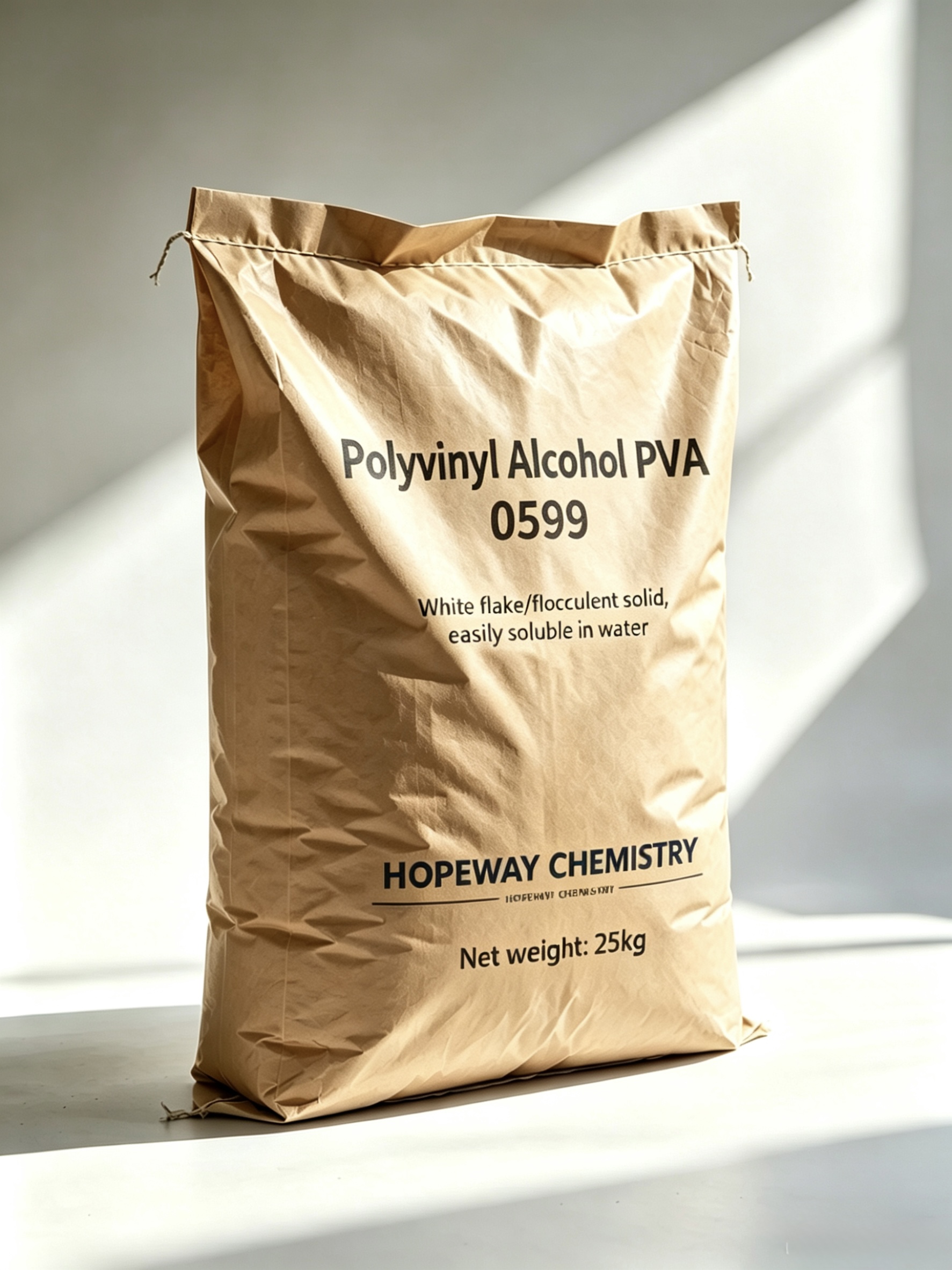
PVA 0599 is the grade whose documented application list includes pharmaceutical coating, slow-release medical substrate, special acetal resin and fine chemical dispersant. Its DP is approximately 500, hydrolysis 98–99%, and viscosity 5–7 mPa·s — the lowest viscosity in the supplied set. For a coating liquor that has to wet out a substrate thinly and evenly, that low viscosity is the practical advantage: it reduces the rheological penalty of building solids, which is the usual reason formulators start reaching for high-DP grades too early.
What the data does not tell you is release kinetics. Nothing in the supplied material records a measured release profile, a dissolution rate, or a validated film thickness for slow-release use. Those are project-specific results that must come from your own substrate testing, not from a grade table.
When higher matrix strength changes the grade choice
If the substrate needs a stronger, more coherent film — higher wet strength before drying, better resistance to mechanical stress during handling, or a film that stays intact longer in an aqueous environment — PVA2499 is the higher-DP fully hydrolyzed option in this catalogue at DP ≈ 2400 and 45–58 mPa·s. PVA1799 at DP ≈ 1700 and 22–30 mPa·s sits between the two.
The trade runs in both directions. A higher-DP grade raises solution viscosity, which can increase coating thickness variation on thin-film equipment, and it changes how the film behaves at the release stage. A team that switches grade to gain strength and then discovers a slower, less predictable release has not solved the problem — it has moved it downstream.
Medical-adjacent non-woven substrates carry a separate requirement set
Where the substrate is a non-woven fiber web rather than a cast film — medical mask or disposable gown constructions, for example — the supplied application data names PVA 0588 applied as a cold-soluble aqueous solution by spray coating onto the fiber web, followed by hot-air drying in a tunnel oven. The stated function is bonding the fiber web to improve tensile strength, with non-toxicity and skin-friendliness as the application premise.
The stated special requirements for that scenario are the checklist a buyer should carry into supplier qualification: ultra-low heavy metal content, formaldehyde-free status, and conformance to medical hygiene certification. In the supplied data these are requirements attached to the application, not certifications already held by a specific grade. Confirm them grade by grade, with documents, before the material enters a hygiene-controlled line.
Scenario B: water-resistant coatings
Powder route: fully hydrolyzed grades where the film meets water
PVA2499 is listed for water-resistant coating, and PVA1799 for water-resistant paper coating. Both are 98–99% hydrolyzed, which is the attribute that matters when the cured film has to resist re-dissolution. The cost is process temperature: PVA1799 is specified as dissolving above 80 °C, and PVA2499 is a hot-water-soluble grade. A plant without hot dissolution and adequate temperature control cannot use this route reliably, no matter how good the dry film is.
Where the coating is applied to paper or board, the supplied application data also gives usable line parameters: cold-water-dissolved PVA 1788 applied by an online sizing machine on a paper machine running 300–800 m/min, with coating oven temperatures of 90–120 °C, followed by roller drying and calendering. The stated function is improving surface smoothness, printability, oil resistance and tensile strength while preventing ink penetration, and the stated special requirements are a low-foam grade, stable viscosity under high-speed stirring, and compatibility with kaolin coating pigment. That is the model for a mild-processing coating line — and the reason 1788 exists alongside the fully hydrolyzed barrier grades.
Emulsion route: VAE 705, 706, 707 and 707H with PVA as protective colloid
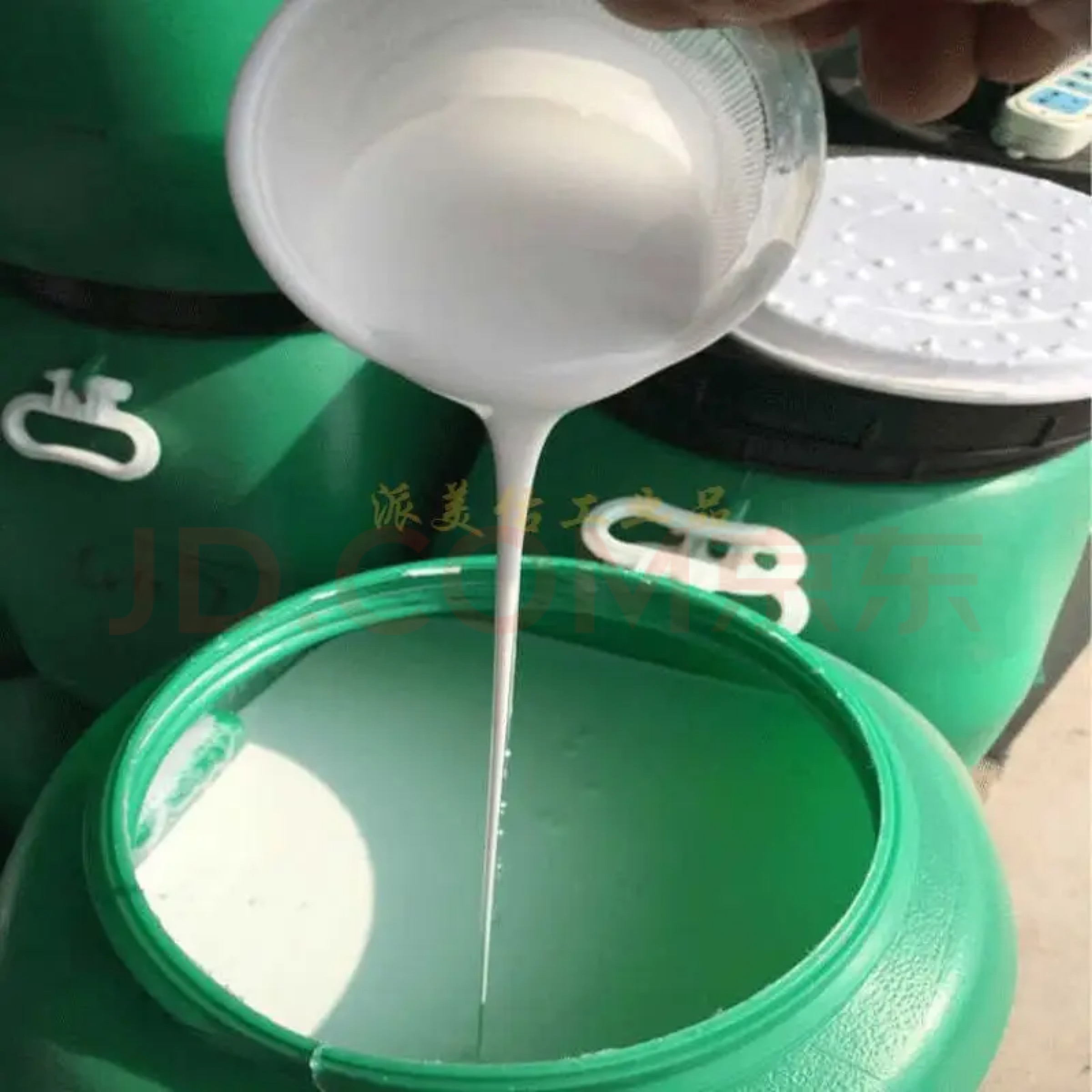
If the project needs a ready-to-use liquid rather than a powder that must be dissolved on site, the VAE emulsion range is the direct alternative. In all four grades the supplied material specification lists vinyl acetate and ethylene as the main monomers and polyvinyl alcohol as the stabilizer and protective colloid, with emulsifier, initiator, pH regulator and deionized water as auxiliaries. The emulsions are described as containing no added plasticizer, non-toxic, zero formaldehyde and fully water-dilutable.
Selection inside the range is driven by viscosity band and stated application, not by a ranking. VAE 707 (500–1000 mPa·s) and 707H (1000–1500 mPa·s) carry the waterproofing and exterior applications: building waterproof coating, roof waterproof primer, exterior elastic coating, concrete repair agent and large-area base coating. VAE 705 (1500–2500 mPa·s) covers paper lamination, carton adhesive, wood white glue and textile fabric compounding. VAE 706 (2500–3500 mPa·s) covers high-strength wood splicing glue, hardcover book binding, cement mortar modification and thick-layer interior coatings.
Two parameters distinguish the grades beyond viscosity. Residual vinyl acetate is specified at 1.0% maximum for 705, 706 and 707, and 0.5% maximum for 707H — a stated parameter, not by itself evidence of compliance with any specific regulation. Minimum film-forming temperature is stated as 0 °C for 705, 706 and 707; it is not stated in the supplied data for 707H, so confirm it if freeze-thaw or low-temperature application is part of the project. Particle size is stated only for 705, at 0.2–2.0 micrometers.
Step-by-step: from substrate requirement to grade family
The decision path below keeps the two scenarios separate until the last step. Each step should produce a written answer, because the failure mode in these projects is usually an unstated assumption rather than a missing grade.
- Write the substrate function statement. Separate matrix functions (film strength, cohesion, adhesion to the carrier) from transport functions (release, barrier, water resistance). A substrate that needs both will usually need a grade compromise or a two-polymer system, and the statement tells you which compromise is tolerable.
- Fix the temperature and equipment window. If the line can hold water above 80 °C with controlled dissolution equipment, the fully hydrolyzed 98–99% family stays open. If the active, the carrier or the plant caps the process below that threshold, the shortlist moves to the cold-water-soluble 87–89% grades: PVA 1788, PVA 2488, and PVA 0588 for spray-applied fiber-web binding.
- Choose the hydrolysis family against the water contact. Cured film that must resist re-dissolution points to PVA2499 or PVA1799. Film that is processed, handled or removed in water points to the cold-soluble grades.
- Choose DP and viscosity inside the family. Thin, uniform coating liquors favour the low end — PVA 0599 at 5–7 mPa·s. Stronger matrices favour the high end — PVA2499 at 45–58 mPa·s or PVA2688 at 55–65 mPa·s within the partially hydrolyzed family. Confirm the viscosity measurement basis before comparing across suppliers.
- Decide powder versus emulsion. A powder route gives direct control of hydrolysis and DP but adds a dissolution step and its failure modes. The VAE route delivers a ready-to-use, water-dilutable binder with PVA already functioning as protective colloid, at the cost of accepting the emulsion's fixed solids, pH and viscosity band.
- Verify before scale-up. Request TDS, MSDS, COA and third-party test reports for the exact grade; run a dissolution trial at your own water hardness and temperature; cast and test a film; and only then convert the trial to a specification.
HOPEWAY's stated capability data supports that last step in practical terms: OEM/ODM customization of mesh size, logo and packaging, small test samples before a bulk order, customization of mesh size, viscosity and hydrolysis degree on request, 100% testing, a 5-ton minimum order quantity and a stated lead time of 7–10 days. Case records show mesh customization at 80–200 mesh for a Brazilian construction-chemical distributor using PVA 1788/2488, and 120–250 mesh for an Indonesian textile mill using PVA1799 — useful evidence that particle-size adjustment is an established part of the supply, not a special request.
Where each route fits: use-case summaries
Slow-release substrate PVA 0599 for thin, low-viscosity coating on a carrier, with release behaviour established in your own testing; PVA2499 or PVA1799 where the matrix must be stronger and the process can handle hot dissolution.
Medical non-woven PVA 0588 as a cold-soluble spray binder for fiber webs, with hot-air drying, subject to confirmed ultra-low heavy metals, formaldehyde-free status and medical hygiene certification for the specific grade.
Water-resistant coating PVA2499 or PVA1799 as the powder barrier route; VAE 707 and 707H where a ready-to-use waterproofing binder is preferred, with VAE 705 and 706 covering paper, wood and mortar-bonding duties at higher viscosity.
Paper and board PVA 1788 cold-dissolved for online sizing and coating at 300–800 m/min, where low foam, viscosity stability under high-speed stirring and kaolin compatibility are the controlling requirements.
Grade comparison: the supplied specification data in one view
| Grade | Hydrolysis | DP | Viscosity (mPa·s) | Dissolution | Documented uses relevant to these scenarios |
|---|---|---|---|---|---|
| PVA 0599 | 98–99% | ≈ 500 | 5–7 | Not stated in supplied data | Pharmaceutical coating, slow-release medical substrate, special acetal resin, dispersant |
| PVA1799 | 98–99% | ≈ 1700 | 22–30 | Above 80 °C | Water-resistant paper coating, high-temperature industrial adhesive, optical film raw material |
| PVA2499 | 98–99% | ≈ 2400 | 45–58 | Hot water soluble | Water-resistant coating, high-strength PVA fiber, PVB resin and film raw material |
| PVA 1788 | 87–89% | ≈ 1700 | 20.5–28 | Cold water soluble | Paper surface sizing, thermal paper coating, construction glue, carton re-moistening adhesive |
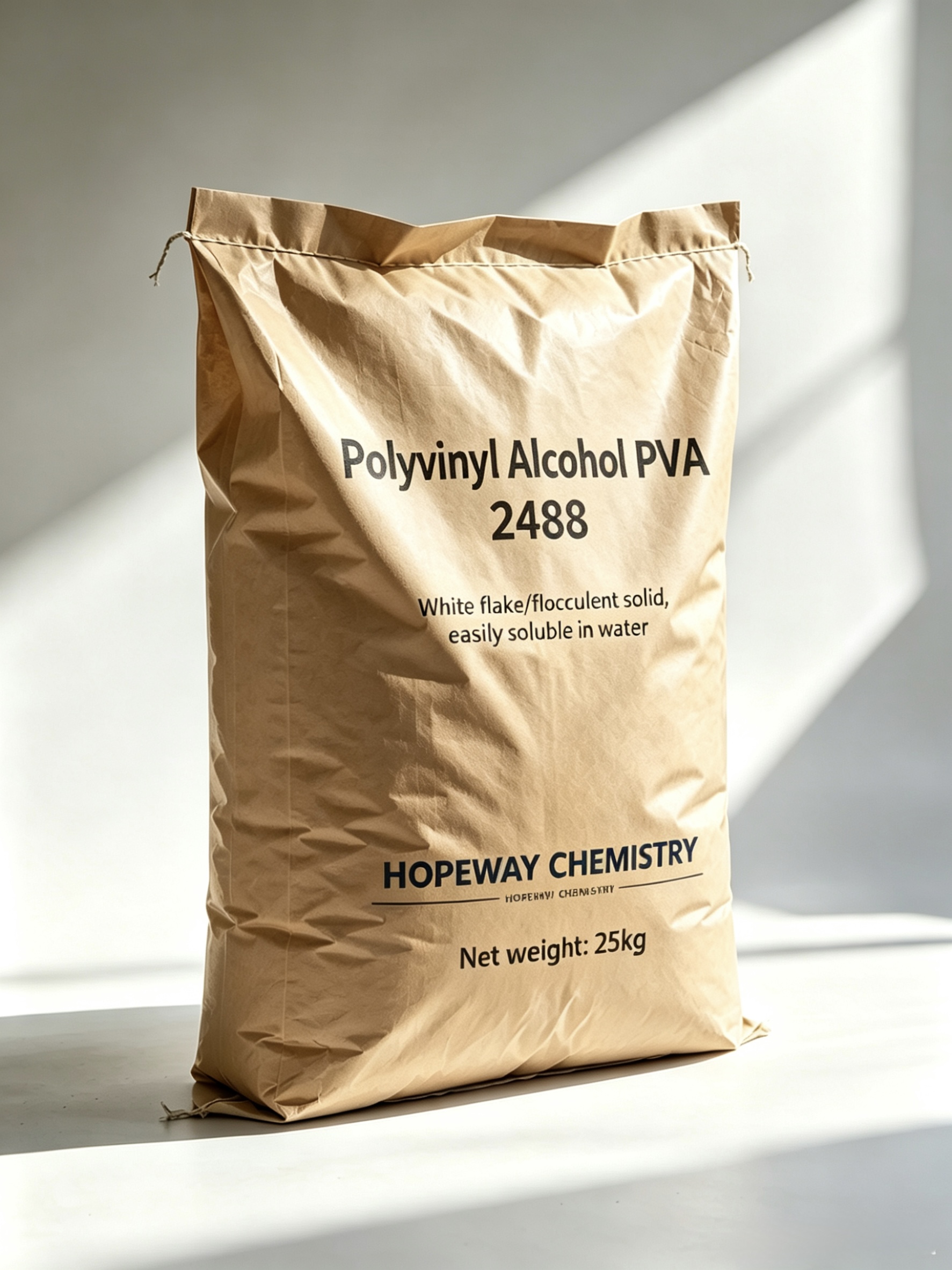
| PVA 2488 | 87–89% | ≈ 2400 | 44–55 | Cold water soluble | Waterproof mortar, thick coating, wood adhesive, exterior wall putty |
| PVA2688 | 87–89% | ≈ 2600 | 55–65 | Not stated in supplied data | High-solid construction glue, thick exterior coating, special carton adhesive |
| PVA 0588 | Not stated | Not stated | Not stated | Described as cold soluble in non-woven binder use | Cold-soluble spray binder for non-woven fiber webs (medical mask, disposable gown) |
| VAE model | Solids (min) | Viscosity at 25 °C (mPa·s) | Ethylene | Residual VAc (max) | MFFT | Documented applications |
|---|---|---|---|---|---|---|
| VAE 705 | 54.5% | 1500–2500 | 14–18% | 1.0% | 0 °C | Paper lamination, carton adhesive, cigarette packaging bonding, wood white glue, textile compounding, interior putty |
| VAE 706 | 55% | 2500–3500 | 14–18% | 1.0% | 0 °C | High-strength wood splicing, hardcover binding, cement mortar modification, thick interior coatings |
| VAE 707 | 54.5% | 500–1000 | 16–18% | 1.0% | 0 °C | Exterior insulation mortar, building waterproof coating, steel structure fireproof coating, roof waterproof primer, concrete repair |
| VAE 707H | 54.5% | 1000–1500 | 16–18% | 0.5% | Not stated in supplied data | Low-cost building waterproof coating, dry-mixed mortar binder, exterior elastic coating, large-area base coating |
Frequently asked questions
Which documentation should we confirm before specifying a PVA grade for a medical-adjacent substrate?
Confirm grade-level documents, not company-level ones. HOPEWAY states that it supplies TDS, MSDS and COA, plus third-party test reports, for inspection and customs clearance. For a fiber-web binder used in mask or gown constructions, the supplied application data names three requirements that have to be verified for the specific grade: ultra-low heavy metal content, formaldehyde-free status, and conformance to medical hygiene certification. Company environmental credentials such as EU EPD, ISCC and EcoVadis describe environmental performance and do not substitute for product-level medical documentation. Ask for the documents against the exact grade and lot you intend to specify.
Can one PVA grade cover both a slow-release substrate and a water-resistant coating?
Not without a trade-off. The two scenarios pull hydrolysis in the same direction but differ on viscosity and processing. PVA2499 is a strong candidate for the coating side and for a stronger substrate matrix, but the supplied data does not list it for slow-release medical substrate, and it requires hot water dissolution. PVA 0599 is the grade documented for pharmaceutical coating and slow-release substrate, at 5–7 mPa·s, but it is not listed for water-resistant coating. Treat a single-grade answer as a hypothesis to be validated, not a selection.
Professional PVA manufacturer for adhesive industry
For adhesive producers, the relevant supply is both the powder and the emulsion. PVA acts as the protective colloid and stabilizer in VAE 705, 706, 707 and 707H, so an adhesive formulator can source the colloid chemistry and the finished emulsion binder from the same range: VAE 705 for paper lamination, carton adhesive and general wood white glue; VAE 706 for high-strength wood splicing and hardcover binding; VAE 707 and 707H for waterproof and construction-related coatings. HOPEWAY states OEM/ODM customization of mesh size, logo and packaging, 100% testing, and customization of mesh size, viscosity and hydrolysis degree.
How are commercial terms structured for a trial followed by a scale-up order?
HOPEWAY's stated capability data lists a 5-ton minimum order quantity and a 7–10 day lead time, with monthly capacity declared in its capability record and annual PVA capacity of 350,000 metric tons. The company reports flexible trade terms including FOB, CFR, CIF and EXW, with T/T and L/C payment, and states that it holds stock for regular clients to shorten delivery. Price is not published by grade in the supplied materials, so quotation follows the grade, mesh size, packaging and volume you specify.
Can we test a grade before committing to a container order?
Yes — the stated after-sales scope includes small test samples for formula trials before a bulk order, plus customization of mesh size, viscosity and hydrolysis degree on request. The company also states free technical guidance on PVA application formulation and dissolution process, with online video consultation. Use that trial to confirm three things the catalogue cannot: your own dissolution behaviour at your water temperature, your film's mechanical and water-contact performance, and the measurement basis behind the viscosity figure you are specifying.
What lead time and shipping terms apply to export orders?
The stated lead time is 7–10 days, with FOB, CFR, CIF and EXW terms and T/T or L/C payment. HOPEWAY reports export revenue at 27.17% of turnover, with PVA exports at 19.6% of PVA sales, and lists Southeast Asia, South Asia, Latin America, Europe, the Middle East and Africa, and North America as main markets, with India as its largest single overseas country for PVA. Document sets are issued in advance to support import clearance.
Conclusion: decide the substrate first, the grade second
The two scenarios in this guide are separated by a small number of verifiable parameters, not by marketing categories. Slow-release medical substrate work starts from PVA 0599, the grade documented for pharmaceutical coating and slow-release medical substrate at 5–7 mPa·s, and moves toward the higher-DP PVA2499 only when a stronger matrix is worth the change in viscosity and the loss of a documented substrate reference. Water-resistant coating work starts from the fully hydrolyzed grades — PVA2499 for water-resistant coating, PVA1799 for water-resistant paper coating — or from the ready-to-use VAE 705/706/707/707H emulsions in which PVA serves as protective colloid. Cold-water processing constraints move the shortlist to PVA 1788, PVA 2488 and PVA 0588.
What remains after grade selection is verification: dissolution trial, film test, and grade-specific documentation. The supplier's capacity, mesh customization and sample service make that verification practical; they do not replace it.
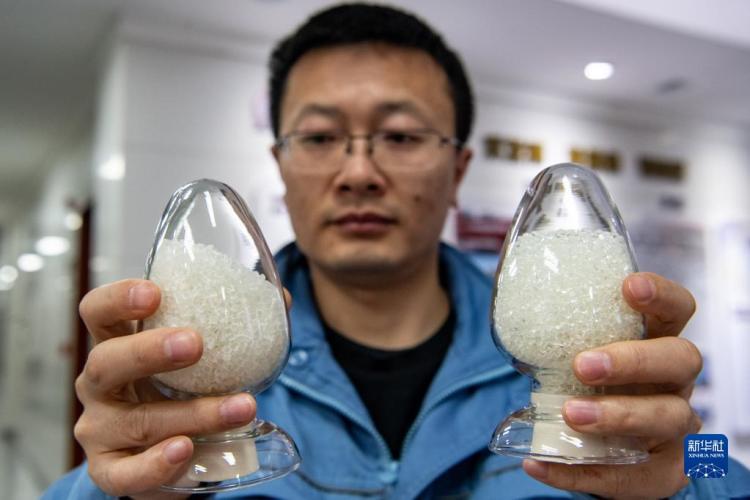
Next step: request a trial sample of the grade your substrate statement points to — PVA 0599, PVA2499, PVA 1788, PVA 2488, PVA 0588, or a VAE 705/706/707/707H emulsion — and run it against your own dissolution and film tests. Grade specifications, packaging options and the full product range are listed in the HOPEWAY PVA catalogue, and company and technical details are available at xmhwchem.com.
Have Questions or Need More Details?
Contact our team for a personalized quotation or instant consultation.
Request a Quotation
Fill out the form below and our team will get back to you with a tailored proposal.
WhatsApp Direct Chat
Prefer to chat in real-time? Message us on WhatsApp for instant assistance & quick answers.
- Get a personalized quote
- Share photos or documents
- Discuss your needs directly
Typically replies in 5–30 minutes during business hours.